

I hear this question a lot, and I love it — because it means you care about what your dog actually feels. Here is the short answer: most dogs don’t instinctively understand kisses, but many learn to enjoy them. A kiss is a human idea.
Your dog doesn’t arrive in your life knowing that pressed lips mean “I love you.” But dogs are brilliant students of human behavior, and over time your dog can connect your kisses with warmth, safety, and good feelings. The real skill is learning to tell the difference between a dog that loves your kisses and one that simply puts up with them.
A dog doesn’t need to understand your kiss to feel your love — but no dog should ever have to just endure it.
What a Kiss Actually Looks Like to Your Dog
Try seeing a kiss through your dog’s eyes for a moment. Dogs never press their mouths against each other’s faces the way we do. When you lean in close, what your dog experiences is a large face suddenly moving into their personal space, lips touching their fur or muzzle, and often a pair of arms wrapping around them at the same time. None of that exists in natural dog behavior.
Dogs are remarkably adaptable, and most learn to read the emotional tone behind our strange human rituals. Your warm voice, your relaxed body, the gentle touch that comes with the kiss: your dog picks up on all of it. But the gesture itself starts out meaningless, which is why the dog’s reaction tells you everything.
If you’ve ever asked yourself, do dogs like when you kiss them, the clearest answer comes from watching your dog in the exact second you lean in. A dog that leans toward you is giving you one answer.
A dog that freezes, turns its head, or ducks away is giving you a very different one. And then there is the deeper question — do dogs know what kisses mean the way we mean them? The honest answer is no, not instinctively. They learn what your kiss predicts: comfort, attention, safety. That prediction is what your dog actually responds to.
Tolerance Is Not the Same as Enjoyment
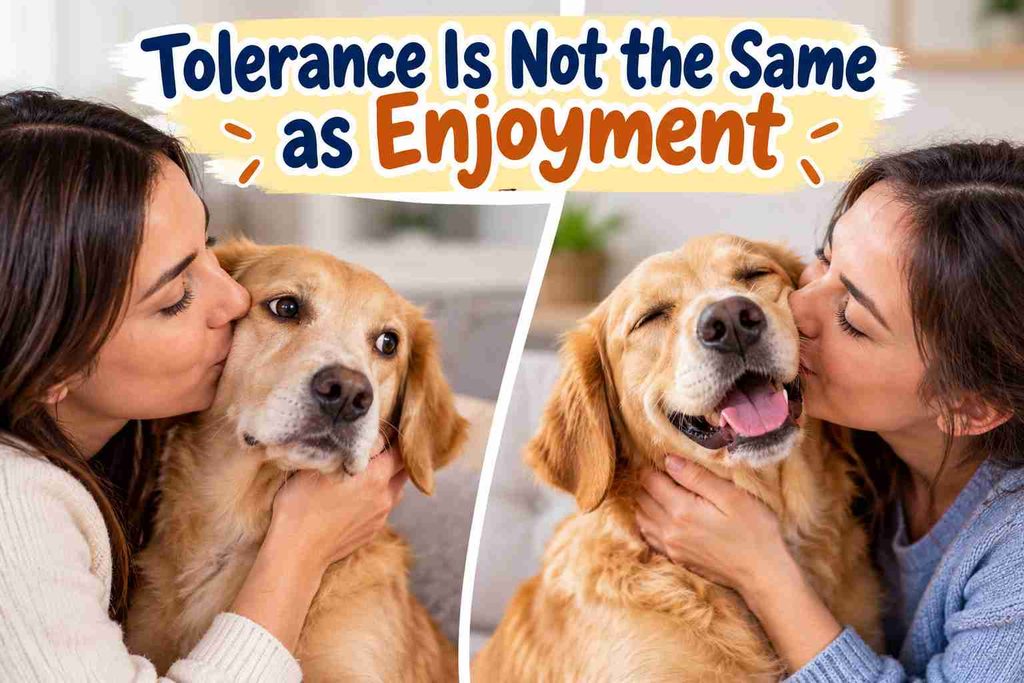
So do dogs like being kissed? Here is the framework I want you to remember, because almost every article on this topic skips it: some dogs genuinely enjoy kisses, and some merely tolerate them. Those are very different things, and loving your dog means knowing which one you’re looking at.
A tolerant dog stays still while you kiss them. They don’t snap, they don’t run, they wait it out. It looks peaceful, so owners read it as happiness. But stillness can also be a polite freeze — the dog’s way of saying “I’ll get through this because I trust you.” Enjoyment looks different: the body stays soft, the dog leans in, maybe nudges your face for more. Tolerance is putting up with the gesture; enjoyment is participating in it.
A dog may love you deeply, and the question — do dogs like it when you kiss them? — still deserves an honest answer: some do, and some are simply being polite about something they’d rather skip. Neither response means your dog doesn’t love you. It just means love and kissing are two separate things in your dog’s mind, and I think that’s worth respecting.
It helps to remember that closeness itself is a compliment in dog language. A dog that lies on top of you is choosing contact on its own terms — pressed against you, relaxed, in control of the moment. That voluntary closeness tells you far more about your bond than any kiss you initiate yourself.
How to Read Your Dog’s Answer
Your dog is constantly telling you how they feel about your kisses — you just need to know what to look for. Watch for these signals the next few times you lean in.
Signs your dog enjoys your kisses
- Soft, loose body — nothing stiff or braced
- Relaxed face with soft eyes, maybe slow blinks
- Leans into you or nudges your face for more
- Loose, easy tail wag (not stiff or tucked)
- Stays close after the kiss instead of moving away
Signs your dog is only tolerating it
- Goes still and waits for it to end
- Turns the head slightly away while staying in place
- Polite, frozen posture with a closed mouth
- Moves away calmly the moment you finish
Signs your dog is stressed by it
- Yawning when they aren’t tired
- Lip licking with no food around
- Turning the whole head or body away
- Freezing completely, going rigid
- Whale eye — the whites of the eyes showing
- Ducking, backing up, or trying to leave
If your dog is whimpering when you lean in for a kiss, take that seriously. Whimpering is not a happy sound in this context — it is your dog asking for space, and the kindest response is to back off and offer affection a different way.
A dog’s answer can also change over time. A nervous rescue that flinched at kisses in month one may lean into them by month six, once trust is built — and a dog that loved kisses as a puppy may go off them when tired or sore. Keep reading your dog instead of assuming the answer stays the same.
What the Science Actually Says
In plain language, here is what scientists have actually found about the bond between dogs and their people.
Researchers have observed that when a dog and its owner gaze into each other’s eyes, both of them show a rise in oxytocin — the same hormone involved in bonding between human parents and babies.
This doesn’t happen with wolves raised by humans, which suggests it developed during the long history of dogs living alongside us. It is one of the strongest pieces of evidence that the dog-human bond runs deeper than simple training and treats.
Other work has shown that dogs read human emotional cues with remarkable skill. They follow our pointing gestures, respond to the tone of our voices, and can tell a happy face from an angry one.
They also form learned associations incredibly fast: a sound, a gesture, or a routine that repeatedly predicts good things becomes something the dog looks forward to. A kiss, delivered with a soft voice and gentle touch over hundreds of repetitions, gets filed in that same category.
So do dogs understand human kisses the way we understand them? The research can’t quite claim that — it’s about bonding and learned associations, not about the meaning of a kiss as a concept.
What it does tell us is an answer to do dogs know when you kiss them: absolutely. They recognize the ritual, they read your emotional state during it, and over time the feeling attached to that moment matters far more to them than the gesture itself.
So when someone tells you “science says dogs love kisses,” take it with a grain of salt. What science actually says is subtler: dogs bond with us deeply, and they learn the meaning of our rituals through the feelings we wrap around them.
What “Kisses” Mean in Dog Language

Here’s the part most articles skip, and it’s my favorite: dogs do have their own versions of kisses. They just don’t look like ours.
Dogs show affection to each other through close, calm body contact. They lean against each other while resting. They sleep pressed together. They groom each other — mutual grooming, like licking another dog’s ears, is one of the clearest affection signals between dogs, and it says “you’re part of my group” more eloquently than any human gesture could.
They also lick each other’s faces, especially puppies licking their mother’s mouth — a behavior rooted in asking for food and comfort that carries into adulthood as a social signal. When your dog licks your face, that is closer to a dog “kiss” than anything you do with your lips. It’s their language, not a copy of ours.
Knowing this reframes the whole question. Ask do dogs like to be kissed, and the honest answer is that so many of them do — once the gesture gets folded into their language of closeness. Your kiss becomes one more form of the physical togetherness they already value: like leaning, like resting against you, like grooming. The kiss itself isn’t the point. The togetherness is.
A Safe Way to Kiss Your Dog
If your dog’s body language says they enjoy your kisses — or at least genuinely don’t mind them — do it in a way that respects how your dog experiences the world. Here is the protocol I recommend:
- Let your dog come to you. Kisses your dog chooses are completely different from kisses you impose. Sit down, invite them close, and let them decide how near they want to be.
- Don’t loom over the head. Bending over a dog and descending toward their face can feel threatening, especially to nervous or small dogs. Get down to their level instead.
- Pick a better spot than the face. You might wonder, do dogs like kisses on the head? For a lot of dogs, the top of the head is actually the least comfortable place to be touched — it’s where looming hands come from. The cheek, the shoulder, or the side of the neck usually goes over much better.
- Keep it brief and read the response. One quick kiss, then pause. Does your dog lean in for more or turn away? Let their answer guide what happens next.
- Never hold them in place. Wrapping your arms around a dog while kissing them removes their option to leave. A dog that can walk away and chooses to stay is telling you something wonderful.
- Watch for the stress list. Lip licking, yawning, turning away, freezing — any of these means stop, no questions asked.
Trust between you and your dog looks like sleeping with their back to you — relaxed, vulnerable, completely at ease. It never looks like enduring something unpleasant. Keep that image in mind and you’ll rarely go wrong.
A note on kids
Children and face kisses are a combination that needs adult supervision, always. Kids tend to hug tightly, kiss directly on the face, and miss the warning signs adults might catch.
Teach children to pet the dog’s side or chest instead of kissing the face, to let the dog walk away whenever it wants, and to never kiss a dog that is eating, sleeping, or caring for puppies. Most dog bites to children involve the face and happen with familiar dogs during exactly these kinds of close-contact moments — this is one rule I never bend on.
Better Ways to Say “I Love You” in Dog Language
If your dog turns out to be a kissing tolerator rather than an enthusiast, you haven’t lost anything — you just get to love them in the language they actually speak. These land harder than any kiss:
- Sniff walks. Let your dog stop and sniff as long as they want. For a dog, the walk is about the smells, not the distance — giving them that time is a genuine gift.
- Calm, slow petting. Long strokes along the side or chest, at your dog’s pace. Many dogs prefer this to excited, fast petting.
- Play on their terms. A game of fetch, tug, or just being silly together builds the bond faster than almost anything else.
- Training with rewards. Short, fun training sessions with treats make your dog feel smart and successful — and they strengthen your communication.
- Predictable routines. Dogs relax when life is predictable. Regular meals, walks, and bedtime tell your dog the world is safe.
- Good food surprises. A stuffed Kong or a little peanut butter on a lick mat delivers joy in a language every dog understands fluently.
And never underestimate edible affection: a smear of peanut butter inside a Kong can turn an ordinary afternoon into your dog’s favorite part of the day.
The common thread is simple: the best affection is the kind your dog gets to participate in. Watch what makes your own dog’s whole body relax with happiness, and do more of that. That’s fluent dog.
Quick Answers to Common Questions
Do dogs understand kisses?
Not instinctively. Dogs aren’t born knowing a kiss means affection, but most figure out the feeling behind it quickly. Through repetition, your kiss becomes a reliable signal of warmth and safety — and that learned meaning is what your dog responds to.
Do dogs know what kisses are?
They don’t have a concept of a kiss. What they know is the pattern: you lean in, your voice goes soft, your body relaxes, and good feelings follow. Dogs are experts at reading patterns, so the ritual makes sense even if the idea of a “kiss” doesn’t exist in their world.
Do dogs like kisses on their head?
Many don’t love it. The top of the head is where looming hands and sudden movements come from, so a lot of dogs find head kisses uncomfortable even when they enjoy affection elsewhere. If you want to kiss your dog, the cheek or shoulder is usually a safer bet — and always check their reaction first.
What do dogs think when you kiss them?
They’re reading the moment, not the concept. Your dog notices your soft voice, your relaxed posture, and your calm attention. Most dogs interpret a gentle kiss as closeness with their favorite person — especially once they’ve learned it predicts good things.
Do dogs feel love when you kiss them?
They feel the emotions around the kiss: your calm affection, your attention, your warmth. A kiss delivered with genuine warmth feeds the real emotional bond dogs share with their owners. The kiss is the wrapper; your feeling is what’s inside.
Does my dog like kisses?
Kiss your dog once, then pause and watch. If they lean in, nudge you, or stay close with a soft body, that’s a yes. If they freeze, turn away, lick their lips, or move off, that’s a no — or at least a “not like that.” Trust what you see over what you hope.
Showing Love in Your Dog’s Own Language
So, do dogs like kisses? Some truly do. Some tolerate them out of love. And some would honestly rather you expressed it differently. All three answers are fine, because the kiss was never really the point.
What matters is that your dog feels safe, understood, and cherished — and your dog is telling you, every single day, exactly how to do that. Read their body, respect their answer, and love them in the language they speak. A dog that trusts you enough to be honest with you is a dog that already knows they’re loved.