

If you’re searching for how to get your dog certified as a service dog, I want to give you the honest answer first: in the United States, there is no official certification process.
No government agency issues service dog certificates, no exam makes your dog “official,” and no website can sell you legitimate paperwork. I know that’s not what many sites tell you — several will happily charge you $80 for a certificate and vest — but knowing the real rules will save you money and protect your rights.
“There is no official service dog certification in the US. What makes a dog a service animal is task training for a disability — not a certificate, vest, or registry entry.”
Here’s what the law actually says, why the online registry industry exists anyway, and what to do instead if you genuinely need a service dog.
The Direct Answer: There Is No Official Certification
Under the Americans with Disabilities Act (ADA), a service dog is defined by two things: the handler has a disability, and the dog is individually trained to perform tasks related to that disability. That’s it. The ADA does not require certification, professional training programs, vests, ID cards, or registration of any kind.
But those businesses are selling products, not legal status. A certificate from an online registry carries no legal weight — and, just as importantly, the lack of one takes nothing away from a genuinely trained service dog. Businesses covered by the ADA are actually forbidden from demanding documentation, so a certificate wouldn’t help you even if it were real.
The confusion is understandable. Service dog handlers face real access challenges, and a shiny ID card feels like armor. But the armor that actually works is knowledge: knowing your rights and having a well-trained dog.
What the ADA Actually Requires
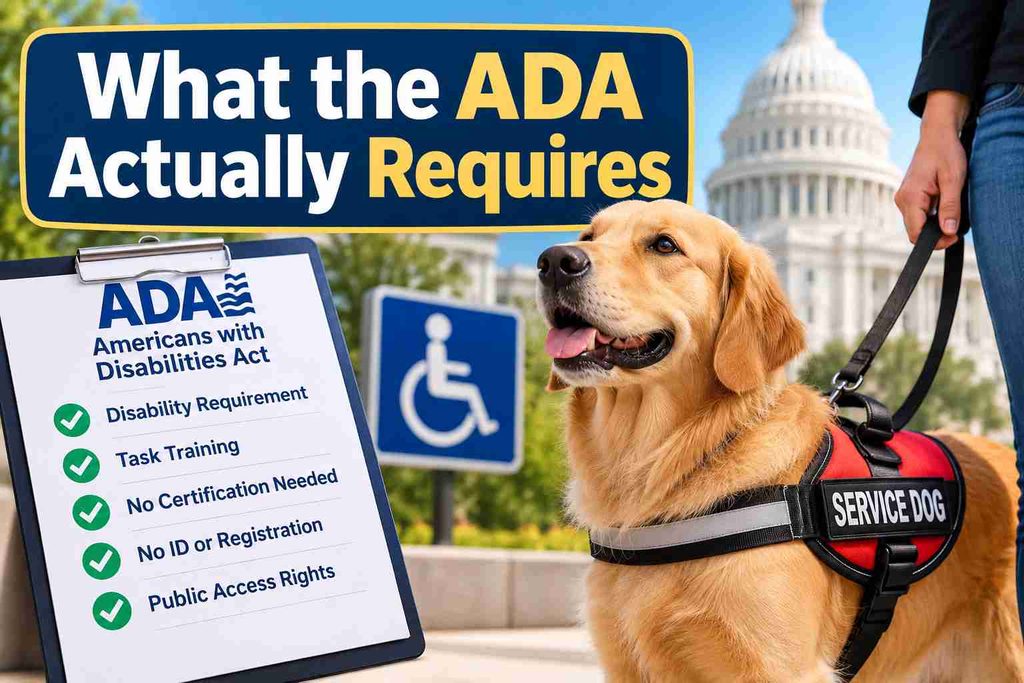
The ADA’s service animal rules are refreshingly simple. For a dog to qualify as a service animal, the handler must have a disability as defined by the ADA, and the dog must be trained to perform specific tasks that mitigate that disability. The ADA’s official service animal guidance spells this out clearly, and it’s worth reading the source directly.
When it comes to what the ADA requires of service dogs, here’s the complete list of what businesses may and may not do. Staff may ask only two questions when it’s unclear whether your dog is a service animal: “Is this a service animal required because of a disability?” and “What work or task has the dog been trained to perform?” They may not ask about your disability, demand documentation, require the dog to demonstrate its task, or insist on a vest or ID.
Task training is the entire ballgame. These ada service dog requirements are refreshingly simple — but they’re also widely misunderstood, which is exactly what the registry industry exploits. The task must be a trained behavior tied to the disability — guiding, alerting to sounds, detecting an oncoming seizure, interrupting a panic attack, retrieving medication.
Mere presence or emotional comfort doesn’t count, no matter how much the dog helps. And the dog must be under control and housebroken; a business can legally remove any dog, service animal or not, that is out of control or not housebroken.
Note the boundary: the ADA covers public places — restaurants, shops, hotels, hospitals. It doesn’t cover airplanes (Air Carrier Access Act), most private housing (Fair Housing Act), or workplaces (EEOC). Each has its own rules, covered below.
The Online Registry Industry (and Why It Means Nothing)
Search for anything about service dog certification and you’ll meet the registry industry: sites offering to “register” your dog in minutes, sell you a certificate, an ID card, and a vest. An online service dog registry is a private business with a database — it has no connection to any government agency, and registration there confers zero legal rights.
These sites rank for certification searches, charge $50–$200 for a package, and ship impressive-looking documents. What they don’t tell you is that no business is allowed to ask for those documents, which makes them useless for access — and that waving a purchased certificate can actually undermine your credibility with gatekeepers who know the law.
The same goes for the service dog identification card. The ADA explicitly prohibits businesses from requiring ID, so an ID card solves a problem that doesn’t legally exist. Some handlers buy vests and cards anyway for convenience, to reduce confrontations. That’s a personal choice — but buy them knowing they’re accessories, not credentials.
I’m blunt about this because the registry industry preys on people at a vulnerable moment — often newly disabled people who just want to do things correctly. Spotting these operations uses the same instincts I describe for how to catch a fake service dog: pressure tactics, official-sounding names, and promises of instant legitimacy are red flags in both worlds.
Real legitimacy comes down to training and behavior, not purchases. If a site tells you otherwise, it’s selling you something.
Service Dog vs. Emotional Support Animal vs. Therapy Dog
Much of the certification confusion comes from mixing up three very different categories. The emotional support animal vs service dog distinction is the one that matters most legally. An emotional support animal (ESA) provides comfort through its presence — no task training required. ESAs have housing protections under the Fair Housing Act, but they have no public access rights. You cannot bring an ESA into a restaurant the way you can a service dog.
Therapy dogs are a third category: dogs trained to provide comfort to other people in hospitals, schools, and nursing homes. They go through temperament testing and certification through private organizations — and that certification is real within its own context, because it’s issued by the organization whose program the dog works in. But a therapy dog certification grants no public access rights either.
Only service dogs — task-trained for a handler’s disability — have broad public access rights. The categories aren’t ranks on a ladder; they’re different jobs with different rules. Knowing which one fits your situation determines everything that follows.
The Real Path: Training Your Own Service Dog
Since no certification exists, the legitimate question becomes how to train a service dog yourself — and the answer is that owner-training is completely legal under the ADA. You are not required to use a professional program. Many handlers train their own dogs, either alone or with a trainer’s guidance.
Service dog training requirements aren’t defined as a curriculum; they’re defined by outcomes. Your dog must reliably perform at least one task related to your disability, remain under control in public, be housebroken, and ignore distractions — food on floors, other dogs, strangers trying to pet. Most owner-trainers spend one to two years reaching that standard, working in stages: basic obedience, task training, then public access proofing.
Beyond task work, a service dog needs rock-solid public manners: walking calmly on a loose leash, settling quietly under tables, ignoring dropped food, and staying neutral around other animals.
A dog that mouths, jumps, or barks at strangers isn’t ready for public access, no matter how good its task work is — impulse control matters as much as skill, which is why I point new trainers to my guide on teaching a dog not to bite before ever entering a store.
Not every dog is suited to this work, and that’s okay. Service prospects need stable temperaments, confidence in new environments, and a genuine enjoyment of training. An anxious, reactive, or fearful dog will struggle no matter how much you invest. An honest temperament assessment early on — ideally with an experienced trainer — saves heartbreak later.
If you want the full roadmap, I break the training journey into steps in my guide to making your dog a service dog — from choosing a prospect through task training to the public access test many handlers use as a graduation benchmark.
One practical note: people often ask how to register a service dog after training, as if registration were the final step. It isn’t — there’s nothing to register with. Your “proof” is a well-behaved, task-trained dog and your knowledge of your rights.
The Program Route: Getting a Professionally Trained Dog
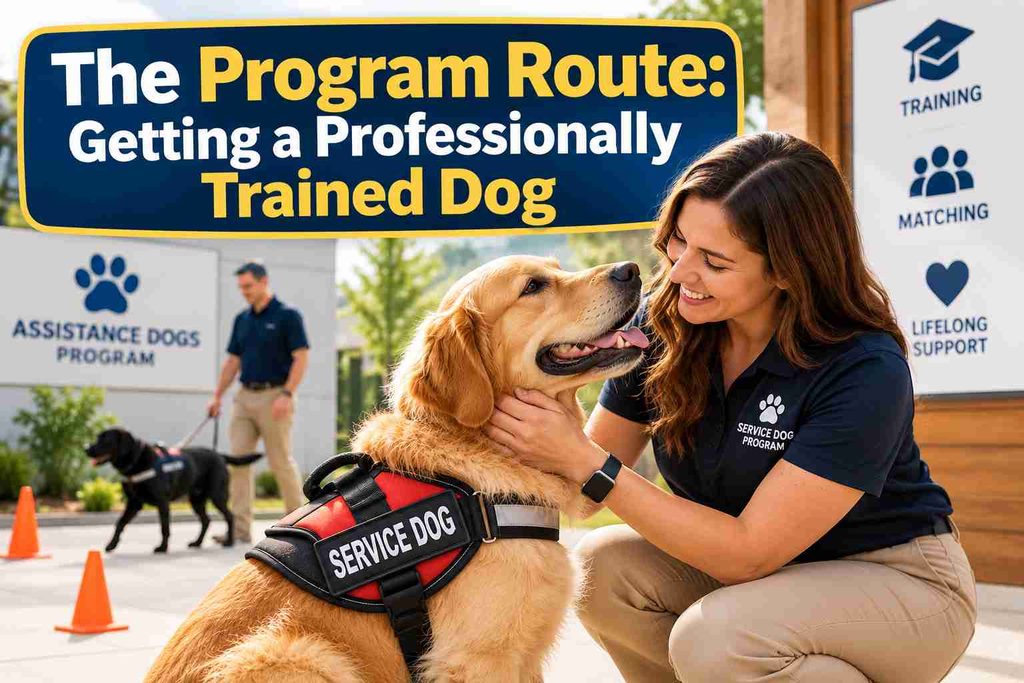
The alternative to owner-training is applying to a service dog program. Reputable programs — many accredited through Assistance Dogs International — breed or select prospects, train them for up to two years, and match them with handlers, including handler training. These dogs are exceptional, and the success rates reflect it.
The trade-offs are cost and time. Program dogs cost $15,000–$50,000+ to train; many nonprofits place them free or at low cost, but waitlists routinely run one to three years. You’ll need a qualifying disability, and most programs interview extensively.
When evaluating programs, watch for the same red flags as the registry sites: guaranteed placement with no assessment, no in-person training component, or pressure to pay upfront before meeting anyone. Legitimate programs are selective — that selectivity is the point.
Psychiatric Service Dogs: A Special Note
Psychiatric service dogs deserve their own mention because they generate the most certification questions. These are service dogs task-trained for mental health disabilities — PTSD, severe anxiety, depression — performing tasks like interrupting panic attacks, creating space in crowds, or waking a handler from nightmares. They are full service dogs under the ADA with identical rights.
The confusion arises because their disabilities are invisible and their tasks are subtle, which invites more gatekeeper challenges. Handlers sometimes hope a certificate will smooth those encounters. It won’t — but knowing the two-question rule cold will, along with training that’s undeniable.
Housing, Flights, and Work: Where Different Rules Apply
The ADA’s public-access rules are only one piece. In housing, the Fair Housing Act covers both service animals and ESAs, and landlords may request documentation of the disability-related need — usually a letter from a healthcare provider.
This is the one context where paperwork genuinely matters, but note what it is: documentation of your need, not certification of your dog. There is no federal ADA service dog certification database that a landlord or airline can check, because no such certification exists.
For flights, the Air Carrier Access Act — not the ADA — sets the rules. Airlines may require a DOT attestation form about your dog’s training, behavior, and health.
And at the airport, remember that detection K9s are screening for substances, not checking your paperwork — it’s the same scent-detection work that lets drug dogs smell edibles through packaging. Your service dog’s legal status comes from its training, not from anything a K9 could sniff.
At work, the ADA’s employment provisions apply, and reasonable accommodation is an interactive process with your employer — medical documentation of your disability is standard there. In all three contexts, the pattern holds: the paperwork that counts relates to the person’s disability, never to a dog certificate.
Frequently Asked Questions
Do service dogs need to be certified?
No. Under the ADA, service dogs are not required to be certified, registered, or professionally trained. The legal standard is task training related to a disability, plus good behavior in public. Any site claiming certification is legally required is misrepresenting the law.
How to get a service dog certificate if I want one anyway?
You can buy certificates, ID cards, and vests from online sellers, but understand what you’re buying: accessories with no legal force. No business may demand them, and they don’t change your dog’s legal status. If a vest reduces daily confrontations for you, that’s a practical choice — just don’t mistake it for a requirement.
How to certify a psychiatric service dog?
The same way as any service dog: through task training, not certification. Train the dog to perform specific tasks tied to your condition — interrupting panic attacks, creating space in crowds, waking you from nightmares — and maintain impeccable public manners. There is no separate psychiatric certification track.
How to get service dog paperwork for housing?
For housing under the Fair Housing Act, ask your healthcare provider for a letter documenting your disability and your disability-related need for the animal. That’s the paperwork landlords may legitimately request. It concerns your medical need, not your dog’s credentials — no dog certificate is involved.
Can a business ask me to prove my dog is a service dog?
They can ask the two permitted questions — whether it’s a service animal required because of a disability, and what task it’s trained to perform. They cannot demand papers, ID, a vest, or a demonstration. If a business insists on documentation, it’s violating the ADA, and you can file a complaint with the Department of Justice.
Does my service dog have to wear a vest?
No. The ADA does not require vests, harnesses, or any identifying gear. Many handlers use vests anyway because they reduce questions from the public, but a dog without a vest has exactly the same rights as one with it. Never let anyone tell you a vestless dog “doesn’t count.”
How long does it take to train a service dog?
Typically one to two years, covering basic obedience, task training, and public access proofing. Rushing usually backfires — a dog pushed into public work before it’s ready can wash out entirely.
Can my landlord require service dog documentation?
Under the Fair Housing Act, landlords may request reliable documentation of your disability-related need for the animal — normally a letter from your healthcare provider. They may not demand a training certificate, registry entry, or demonstration of tasks.
Can any breed become a service dog?
Legally, yes — the ADA places no breed restrictions on service dogs. Practically, temperament matters more than breed: confidence, focus, and enjoyment of training predict success. That said, check your local laws, since some municipalities have breed-specific rules that can complicate things.
Certification Isn’t the Goal — Capability Is
The search for service dog certification ends where the real work begins. No certificate will ever matter as much as a dog that performs its tasks reliably and behaves impeccably in public — because that’s the actual legal standard, and it’s also what keeps you safe and independent day to day.
If you need a service dog, skip the registry checkout pages. Talk to your healthcare provider, decide between owner-training and a program, and invest your energy in training. The handlers with the fewest access problems aren’t the ones with the fanciest ID cards — they’re the ones whose dogs’ training speaks for itself.
And if anyone tries to sell you official-looking paperwork, you’ll now know exactly what it’s worth.