

Cavapoos usually grow into small dogs weighing about 8–25 pounds and standing around 9–14 inches tall. Their adult size depends mostly on their Poodle parent, genetics, and the size of both parents. Most Cavapoos are close to their full-grown size by 10–12 months, although some continue filling out longer.
In this article, you’ll discover how big Cavapoos get, when they stop growing, what affects their size, and how to estimate their adult weight.
Cavapoo Basics: What Makes Their Size Unique?
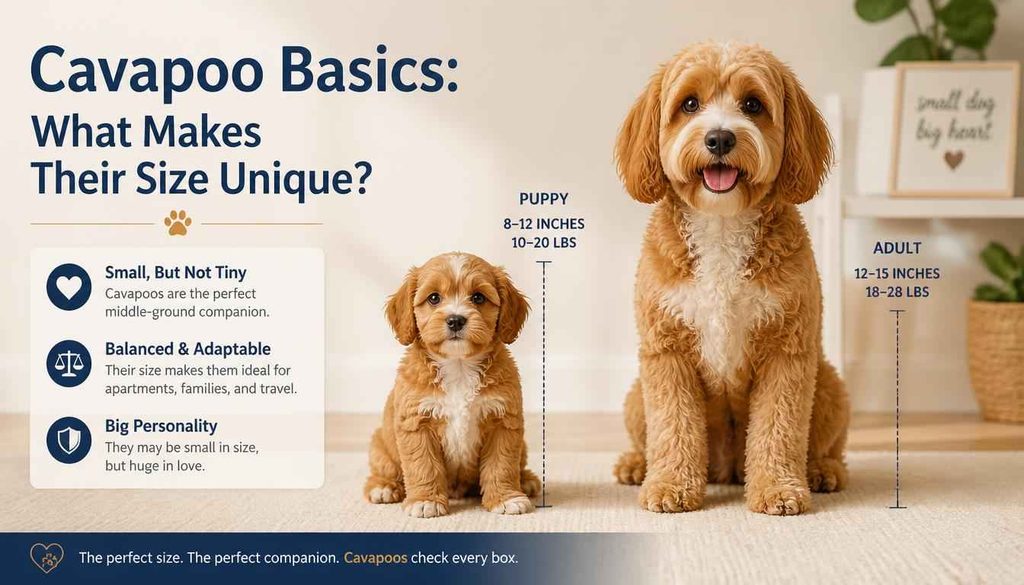
A Cavapoo is a cross between a Cavalier King Charles Spaniel and a Toy or Miniature Poodle. Because the Poodle parent can be different sizes, there is no single size that fits every Cavapoo.
Cavalier King Charles Spaniels generally weigh about 13–18 pounds, while Toy and Miniature Poodles are considerably different in size. This means two Cavapoo puppies from different parents can grow into noticeably different adults.
The best way to predict your puppy’s future Cavapoo full grown size is to look at the parents, the Poodle type, and the growth pattern of previous puppies from the same pairing.
How Big Do Cavapoos Get as Adults?
A full-grown Cavapoo commonly weighs 8–25 pounds and stands approximately 9–14 inches tall. PetMD’s current veterinary-reviewed breed guide places the typical adult range in this same general range.
A simple Cavapoo size chart looks like this:
| Cavapoo Type | Adult Weight | Adult Height |
| Toy Cavapoo | About 7–13 lb | About 9–11 in |
| Mini Cavapoo | About 13–25 lb | About 11–14 in |
These are useful ranges rather than guarantees. A puppy can fall outside them because inherited genes do not always produce a predictable middle point.
A toy Cavapoo full grown size is usually smaller and lighter, while a mini Cavapoo full grown size tends to be taller and more substantial.
Cavapoo Puppy Growth Timeline
Knowing what to expect at different ages makes puppy growth much easier to understand.
8 Weeks: Going Home
At around 8 weeks, many Cavapoo puppies are still very small. Toy puppies may weigh roughly 2–4 pounds, while Mini Cavapoos may be around 3–6 pounds.
Don’t worry if two puppies from the same litter have different weights. Early growth can vary considerably between individual puppies.
3 Months Old
At about 12 weeks, a Cavapoo usually begins looking more like a small dog than a tiny puppy. A Toy Cavapoo may weigh around 4–7 pounds, while a Mini Cavapoo may be around 6–10 pounds.
Your veterinarian can track your puppy’s body condition and growth rather than relying on weight alone.
6 Months Old: Halfway Point (or More)
By six months, many Cavapoos have gained a large portion of their adult size. A rough estimate is that some may have reached around 50–75% of their eventual adult weight, although individual growth patterns vary.
This is why a puppy that looks surprisingly small at four months can still become a perfectly normal adult Cavapoo.
12 Months and Beyond: Near Adult Size
Most Cavapoos are close to their adult height and weight by 10–12 months. Some continue to develop muscle and fill out after their first birthday.
So, when do Cavapoos stop growing? Usually, major growth slows substantially around one year, but the exact timing depends on genetics and individual development.
What Affects How Big a Cavapoo Gets?
Several factors can influence your puppy’s final size.
Size of the Parents
Genetics is one of the strongest clues. If both parents are smaller, their puppies are more likely to remain toward the lower end of the expected range. Larger parents may produce larger puppies.
Ask the breeder for the actual adult weights of both parents rather than relying only on labels such as “Toy” or “Mini.”
Toy vs. Miniature Poodle
The Poodle parent’s size can make a major difference.
A Toy Poodle parent generally produces a smaller Cavapoo, while a Miniature Poodle parent can produce a taller and heavier dog. This is the main reason the miniature Cavapoo size can be noticeably different from a Toy Cavapoo.
Gender
Male Cavapoos may sometimes be slightly larger than females, but gender is not a reliable way to predict adult size. A larger female can easily outweigh a smaller male.
Parents and individual genetics usually tell you more.
Nutrition and Activity
Good nutrition supports normal growth, but feeding extra food will not make a puppy grow taller. Overfeeding can instead contribute to excess body fat.
A complete, life-stage-appropriate diet and sensible portions help puppies develop healthy bones, muscles, and body condition. WSAVA recommends choosing diets that meet recognized nutritional standards and match the pet’s life stage.
How to Estimate Your Cavapoo Puppy’s Adult Size
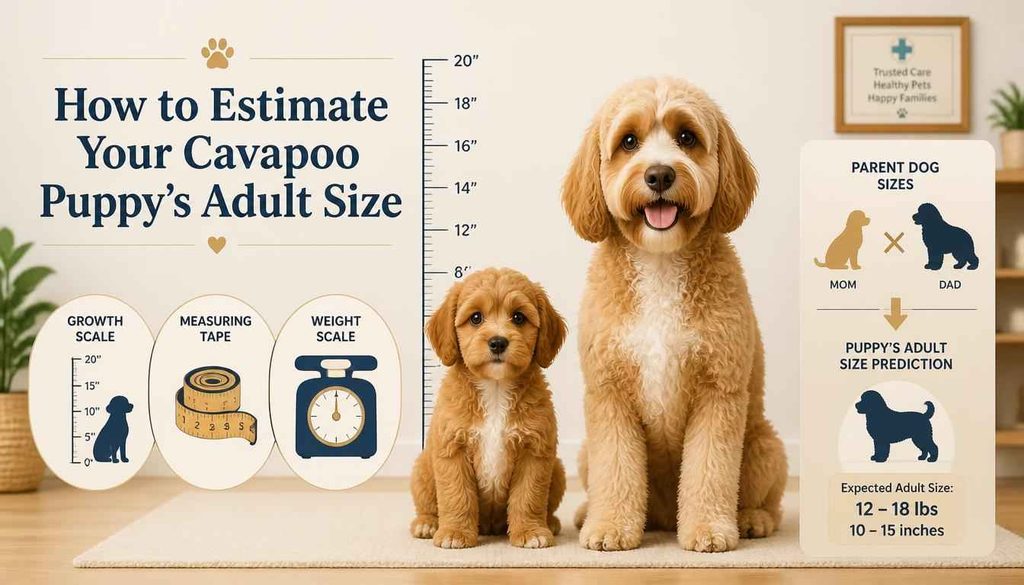
There is no perfect formula for predicting a mixed-breed puppy’s final size, but several clues can help.
Double the 4-Month Weight (Rough Estimate)
You may hear the rule that doubling a puppy’s four-month weight can estimate adult weight.
For example, a 7-pound puppy at four months would produce a rough estimate of 14 pounds.
Treat this only as a rough estimate, not a scientific guarantee. Mixed-breed puppies can grow at different rates.
Ask Your Breeder for Past Litter Averages
This can be one of the most useful clues. A knowledgeable breeder may have records showing how large puppies from the same parents became as adults.
Ask about previous puppies at one year of age, including both their weight and general build.
Look at the Parents’ Weights
Parents can provide a useful size range. If both parents are small, your puppy may also remain small. If one parent is considerably larger, there can be more variation.
For the most reliable picture, combine parent size with your puppy’s current growth and your veterinarian’s assessment.
Cavapoo Height vs. Weight
Height and weight do not always increase together. Two Cavapoos can have the same height but different weights because their body structures and muscle mass differ.
For example, one 12-inch Cavapoo may have a lighter frame while another may look sturdier at the same height.
Rather than chasing a particular number on a toy Cavapoo weight chart, focus on healthy body condition. Your veterinarian can determine whether your puppy’s weight is appropriate for its frame.
Cavapoo Health, Diet & Care
Size is only one part of raising a happy Cavapoo. Because this mix combines Cavalier and Poodle genetics, responsible owners should also understand potential health and care needs.
Cavapoo Health Issues
Cavapoos can inherit health concerns associated with either parent breed. The American Kennel Club notes that Cavalier King Charles Spaniels can be predisposed to eye conditions, patellar luxation, hip dysplasia, mitral valve disease, and syringomyelia.
Hip Dysplasia
Hip dysplasia occurs when the hip joint develops abnormally. It can cause discomfort and mobility problems. Maintaining a healthy weight is important for protecting joints.
Patellar Luxation
Patellar luxation occurs when the kneecap moves out of its normal position. It is particularly relevant to small dogs, so regular veterinary examinations are worthwhile.
Eye Conditions
Eye problems can occur in Cavalier and Poodle lines. Watch for redness, discharge, squinting, cloudiness, or changes in vision and contact your veterinarian if they appear.
Syringomyelia and Chiari-like Malformation (CLM)
These neurological conditions are associated with Cavalier genetics. Signs can include unusual scratching, discomfort, sensitivity around the neck, or changes in movement. Persistent symptoms deserve veterinary attention.
Dental Problems
Small dogs can be prone to dental disease. Regular toothbrushing, professional veterinary care, and routine dental checks can help protect your Cavapoo’s mouth.
Heart Disease
Mitral valve disease is an important health concern in Cavalier King Charles Spaniels. Responsible breeding and regular veterinary monitoring can help identify heart problems early.
Allergies
Some Cavapoos can develop skin or food-related allergies. Itching, repeated ear problems, redness, or digestive changes should be discussed with your veterinarian rather than treated at home without guidance.
What to Feed a Cavapoo
Choose a complete diet appropriate for your dog’s life stage, size, and individual needs. WSAVA recommends looking for transparent nutritional information and diets formulated around established nutrient requirements.
How to Feed a Cavapoo
Puppies generally need smaller, more frequent meals than adults. Follow the food manufacturer’s feeding guidance as a starting point, then adjust with your veterinarian based on growth, activity, and body condition.
How Much Should You Feed a Cavapoo?
There is no single portion that works for every Cavapoo. Age, weight, activity level, food calories, and body condition all matter.
Treats should also be counted as part of the daily calorie intake.
Nutritional Tips for Cavapoos
Avoid assuming that more food means better growth. A healthy puppy needs balanced nutrition, not excess calories.
Do not add supplements unless your veterinarian recommends them for your individual dog.
Behavior and Training Tips for Cavapoos
Cavapoo Personality and Temperament
Cavapoos are generally friendly, affectionate, playful, and people-oriented. Their Cavalier and Poodle heritage can make them intelligent companions that enjoy spending time with their families.
Cavapoo Behavior
Because they often form strong bonds with people, some Cavapoos may struggle when left alone. Early socialization, positive training, enrichment, and gradual alone-time practice can help.
Fun Activities for Cavapoos
Great activities include:
- Short walks
- Fetch
- Trick training
- Food puzzles
- Obedience games
- Gentle play
- Interactive toys
Their small size does not mean they lack energy or curiosity.
Cavapoo Grooming Guide
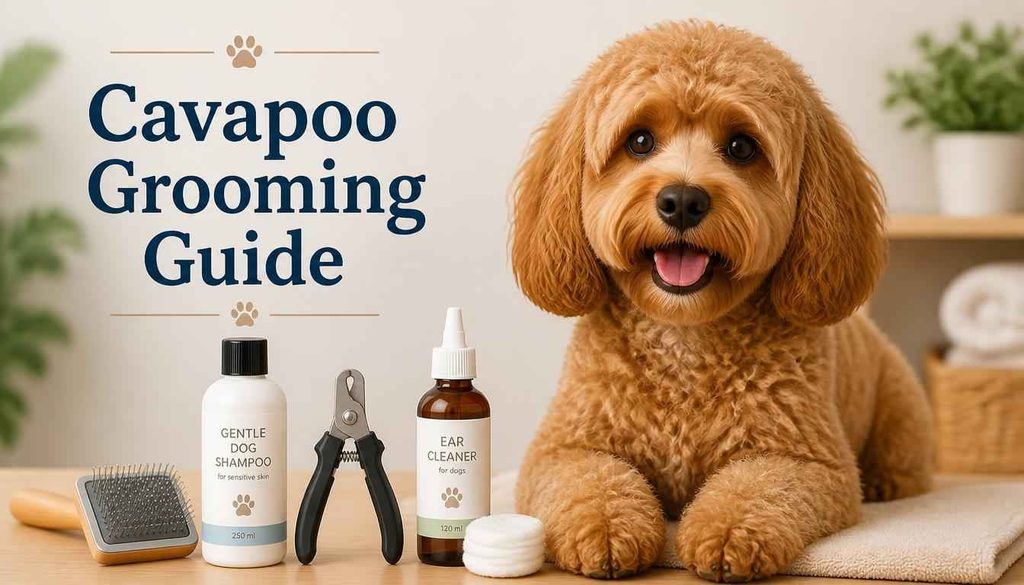
Cavapoo coats can range from wavy to curly and often need consistent grooming to prevent tangles and mats. Like other dog breeds, Cavapoos also have physical traits that can vary by their parent breeds, including features such as their paws and feet. If you’re curious about how these features differ among breeds, learn more about what dogs have webbed feet.
Skin Care
Check the skin regularly for redness, itching, irritation, or unusual bumps.
Coat Care
Regular brushing helps prevent painful mats and keeps your Cavapoo’s coat looking healthy. If you’re interested in other small, low-shedding breeds, you can also learn do Havanese dogs shed and how their coat care compares.
Eye Care
Keep the area around the eyes clean and watch for discharge, redness, or squinting.
Ear Care
Cavapoos can have hairy, floppy ears that need regular checks. Ask your veterinarian or groomer about safe cleaning if wax or debris builds up.
Nail Care
Trim nails regularly so they do not become excessively long and affect comfortable movement.
Considerations for Pet Parents
A Cavapoo can be an exciting choice for families looking for a small, affectionate companion. Before choosing a puppy, ask the breeder about the adult size of both parents, previous litter sizes, health screening, and veterinary records.
Responsible breeding matters because health testing can help breeders make better decisions about inherited conditions. The OFA maintains health-screening databases covering hips, eyes, heart, patellas, and genetic diseases.
Most importantly, don’t choose a puppy only because you want a specific number on the scale. A healthy, well-proportioned Cavapoo is a much better goal than an exact weight.
FAQs
How big does a Cavapoo get?
Most Cavapoos are around 8–25 pounds and 9–14 inches tall when fully grown. Their final size depends largely on their parents and whether the Poodle parent is Toy or Miniature.
When do Cavapoos stop growing?
Most are close to their adult size by around 10–12 months, although some may continue filling out after their first birthday.
What is the full grown Cavapoo weight?
A typical full-grown Cavapoo weighs about 8–25 pounds, although individual dogs can fall outside this range.
Is a Cavapoo hypoallergenic?
Cavapoos are not truly hypoallergenic, but their often low-shedding coats may produce fewer allergens than many other dog breeds.
How long do Cavapoos live?
Cavapoos usually live around 12–15 years when given good nutrition, regular veterinary care, exercise, grooming, and plenty of loving attention.
How much do Cavapoos cost?
Cavapoo puppies commonly cost around $2,000–$4,000 from reputable breeders, although prices vary based on location, breeder, health testing, and pedigree.
What is the difference between Cavapoos vs. Cockapoos?
A Cavapoo mixes a Cavalier King Charles Spaniel with a Poodle, while a Cockapoo mixes a Cocker Spaniel with a Poodle.
Are Cavapoos high maintenance?
Cavapoos need regular brushing, grooming, training, and companionship. Their exercise needs are moderate, but their coats and people-focused nature require consistent care.
How big is a Cavapoo at 8 weeks?
At eight weeks, most Cavapoos weigh about 2–6 pounds, depending on their parents and whether they come from Toy or Miniature Poodle lines.
Are Cavapoos considered small or medium dogs?
Most Cavapoos are considered small dogs, usually weighing under 25 pounds. Larger Mini Cavapoos may approach the lower end of medium size.
Can a Cavapoo be larger than 25 pounds?
Yes, some Cavapoos can exceed 25 pounds, especially when larger parents contribute their genes. Parent size is one of the best clues.
Are Toy Cavapoos much smaller than Mini Cavapoos?
Yes, Toy Cavapoos are usually smaller and lighter than Mini Cavapoos. Toy Cavapoos often weigh 7–13 pounds, while Minis can reach 25 pounds.
How big will your cavapoo get?
So, how big do Cavapoo dogs get? Most grow into small, manageable companions weighing roughly 8–25 pounds and standing 9–14 inches tall.
Your puppy’s final size will depend mainly on genetics, parent size, and whether the Poodle parent is Toy or Miniature. Instead of worrying about one exact number, watch for steady growth, healthy body condition, good nutrition, and regular veterinary care.
With the right care, your tiny Cavapoo puppy can grow into a confident, happy companion—and every stage of that growth can be part of the fun.