

You can identify a potentially fake service dog by observing its behavior and, when legally permitted, asking two ADA questions about the dog’s disability-related work or tasks. Red flags include aggression, uncontrolled barking, jumping, wandering, poor handler control, and repeated disruptive behavior.
Spotting a fake service dog isn’t always easy—learn the key behavior signs, legal questions, and simple steps to protect genuine service dog rights.
What Is a Service Dog?
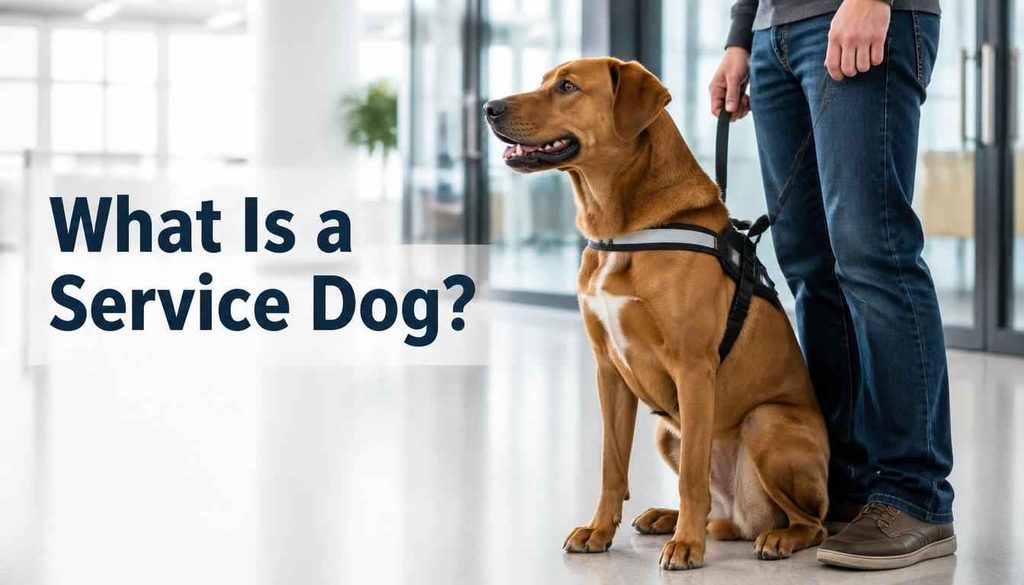
A service dog is a dog individually trained to perform work or tasks for a person with a disability. Under the Americans with Disabilities Act (ADA), service dogs can assist with physical, sensory, psychiatric, intellectual, and other disabilities.
Their work can be highly visible, such as guiding a person who is blind, or less obvious, such as alerting someone to a medical condition or helping with a psychiatric disability. Because disabilities are not always visible, the person’s appearance is never a reliable way to judge whether a service dog is legitimate.
A service dog also does not have to come from a particular organization or wear special equipment. The ADA does not require a service dog to be certified, registered, licensed, or identified with a vest. A person with a disability may also train their own service dog.
This is why learning how to spot a fake service dog should focus primarily on the dog’s conduct and the legally permitted questions—not on judging the handler.
What’s the Difference Between a Service Dog and an Emotional Support Animal (ESA)?
The key difference is training and function. A service dog is trained to perform specific work or tasks related to a person’s disability. An emotional support animal provides comfort or emotional support but is not trained to perform disability-related tasks in the way a service dog is.
This distinction also affects public access rights. Under the ADA, emotional support animals do not have the same public-access protections as service dogs. Other laws may provide different protections in housing or transportation, so the rules can depend on the situation.
In simple terms, real vs fake service dog questions should not be reduced to whether the animal helps its owner emotionally. What matters is whether the dog meets the applicable legal definition and is trained to perform disability-related work or tasks.
Where Can Service Dogs Go?
Service dogs generally have broad access to places covered by the ADA, including many businesses, restaurants, stores, government facilities, and other public areas.
You cannot decide that a dog is fake simply because you see it in a place where ordinary pets are not allowed. In fact, legitimate service dogs are specifically protected in many such settings.
Air travel has additional rules. Under current U.S. Department of Transportation regulations, airlines recognize trained service dogs and may use specific DOT forms and behavioral requirements for air transportation. Airlines can refuse transportation in certain circumstances, such as when a dog poses a direct safety threat or causes significant disruption.
Tasks That Service Dogs Might Complete
Service dogs can perform many different tasks depending on their handler’s disability. Some may guide people who are blind, alert people who are deaf, retrieve objects, provide mobility assistance, interrupt harmful behaviors, or alert a person to certain medical conditions.
The important factor is not how impressive the dog looks but whether it has been trained to perform disability-related work or tasks.
Working dogs can also receive highly specialized scent training for jobs unrelated to service work. For example, if you are interested in how dogs detect particular odors, you can learn more about can drug dogs smell edibles.
10 Ways to Catch a Fake Service Dog
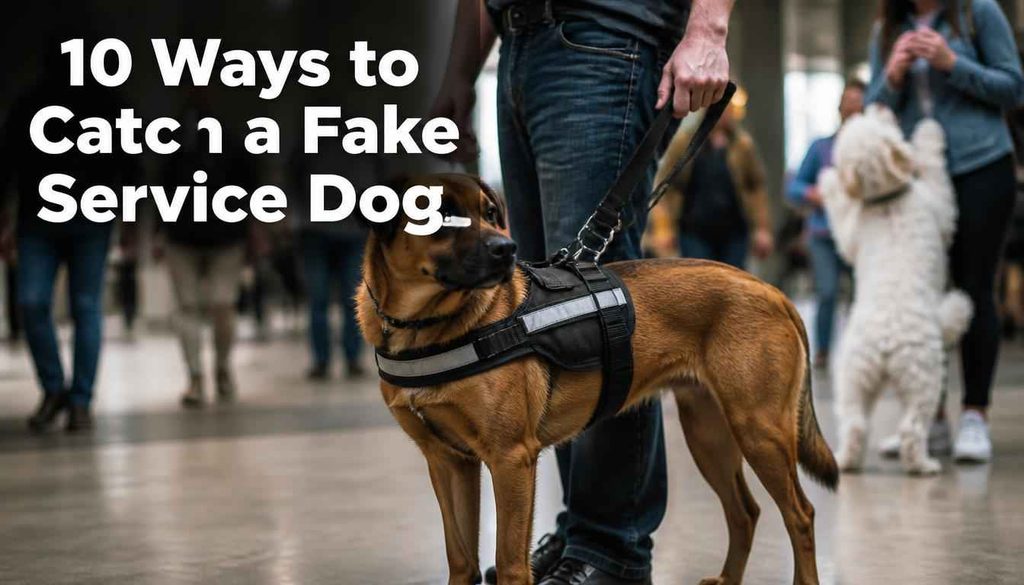
Learning how to identify a fake service dog starts with observation. You should look at the dog’s behavior rather than its breed, size, color, vest, or the appearance of its handler.
One unusual moment does not automatically prove fraud. Dogs can have unexpected reactions, and disabilities can affect how a handler interacts with their animal. Look for a consistent pattern of behavior before drawing conclusions.
1. Aggression
Aggressive behavior can be a serious warning sign. A dog that repeatedly growls, lunges, snaps, bites, or threatens people without an appropriate reason may not be adequately controlled in a public environment.
A legitimate service dog is expected to remain under its handler’s control. The U.S. Department of Transportation also considers disruptive or threatening behavior when determining whether a service dog can travel by air.
However, don’t deliberately provoke a dog to test it. Never touch, tease, call, or approach an unfamiliar service dog to see how it reacts.
2. Lack of Discipline
A service dog should generally be focused on its handler and under control.
Repeatedly jumping on people, running toward strangers, pulling uncontrollably, playing with other animals, or ignoring the handler can be meaningful warning signs.
The important word is repeatedly. One distraction does not automatically mean the dog is fake. Even highly trained animals can notice something unexpected.
When considering how to tell if a service dog is real, look at the overall pattern: Is the dog controlled, calm, and responsive to its handler?
3. They’re Being Carried
Seeing a dog being carried does not prove that it is fake.
Service dogs come in different sizes, and a dog may sometimes need to be carried for a particular reason. Air travel can also involve specific arrangements for smaller service dogs.
So this should never be treated as a stand-alone test.
If you’re trying to how to tell a fake service dog based on appearance alone, you may easily make the wrong judgment. Behavior and legally relevant information are much more useful.
4. Not Leash-Trained
A service dog should generally be under the handler’s control. Depending on the circumstances, that control can be provided through a leash, harness, tether, voice, signals, or other effective methods.
A dog that repeatedly drags its handler, runs away, or cannot be controlled may raise legitimate concerns about its training.
However, the ADA does not require every service dog to be physically tethered. A person may be unable to use a leash because of a disability, or a leash may interfere with the dog’s work. In those circumstances, effective voice or signal control may be appropriate.
5. Barking, Howling, or Whining
Repeated barking, howling, whining, or other disruptive behavior in public can be a warning sign.
A trained service dog is expected to behave appropriately in public. The DOT specifically notes that disruptive behaviors such as barking, snarling, running around, or jumping on other passengers can affect whether an animal is accepted for air transportation.
Still, context matters. A brief sound does not automatically make a service dog fake. Look for ongoing, uncontrolled disruption.
6. Sniffing or Exploration
Ordinary pet behavior can sometimes raise questions.
A dog that repeatedly wanders away, investigates strangers, pulls toward food, or spends most of its time exploring instead of staying focused on its handler may not be appropriately trained for public work.
But don’t expect a service dog to behave like a robot. Dogs can naturally notice their surroundings. The better question is whether the dog can return its attention to its handler and remain under control.
7. Not Responding to Commands
A service dog should be responsive to its handler’s directions or signals.
If a dog repeatedly ignores its handler, refuses to follow instructions, or cannot be brought under control, that can be a significant concern.
But there is one important limitation: you should never test the dog yourself. A service dog is trained to respond to its handler, not random members of the public.
Do not call the dog, give it commands, offer food, or attempt to make it demonstrate a task.
8. Not the Right Service Dog Breed
Breed is not a reliable way to identify a fake service dog.
This is an important correction to some older online advice. The ADA does not restrict which dog breeds can be service animals. A breed that is less commonly seen in service work can still legitimately assist a person with a disability.
Labrador Retrievers, Golden Retrievers, and other breeds may be commonly associated with service work, but that does not make another breed automatically suspicious.
So if you’re learning how to verify a service dog, don’t use breed as your verification method.
9. You Don’t Notice a Service Dog Vest or Gear
A vest, patch, ID card, or special harness can make a service dog easier for the public to recognize—but none is required by the ADA.
This means a dog without a vest can still be a legitimate service dog.
Likewise, a dog wearing a convincing-looking vest is not automatically legitimate. Anyone can purchase products that make an ordinary pet look like a working animal.
If you’re wondering how to spot a fake service dog certificate or how to spot a fake service dog ID, remember that there is no universal ADA certification or registration system that proves a dog is a service animal. The Department of Justice does not recognize purchased certification or registration documents as proof under the ADA.
10. Ask the Right Questions
If you’re a covered business or public entity and it is not obvious that the dog is a service animal, the ADA allows only two specific questions:
- Is the dog a service animal required because of a disability?
- What work or task has the dog been trained to perform?
You cannot ask what the person’s disability is. You also cannot demand medical records, certification, registration papers, or require the dog to demonstrate its task.
A vague answer or an answer describing only comfort may raise questions, but businesses should still apply the rules carefully rather than accusing someone of fraud.
Spotting a Fake Service Dog
Knowing the signs of a fake service dog can help you recognize concerning behavior without making unfair assumptions about a handler. The most useful approach is to focus on repeated, obvious behavior problems rather than a dog’s appearance, breed, vest, or paperwork.
A dog that is repeatedly aggressive, uncontrolled, excessively disruptive, or unable to remain under its handler’s control may deserve attention. Even then, these behaviors do not automatically prove that the handler is falsely claiming a service animal.
Specialized dog training can involve very different abilities and purposes. For example, dogs can be trained to recognize specific scents, which is why questions such as can drug dogs smell nicotine are also useful when learning about working-dog abilities.
When Can a Legitimate Service Dog Be Denied Access?
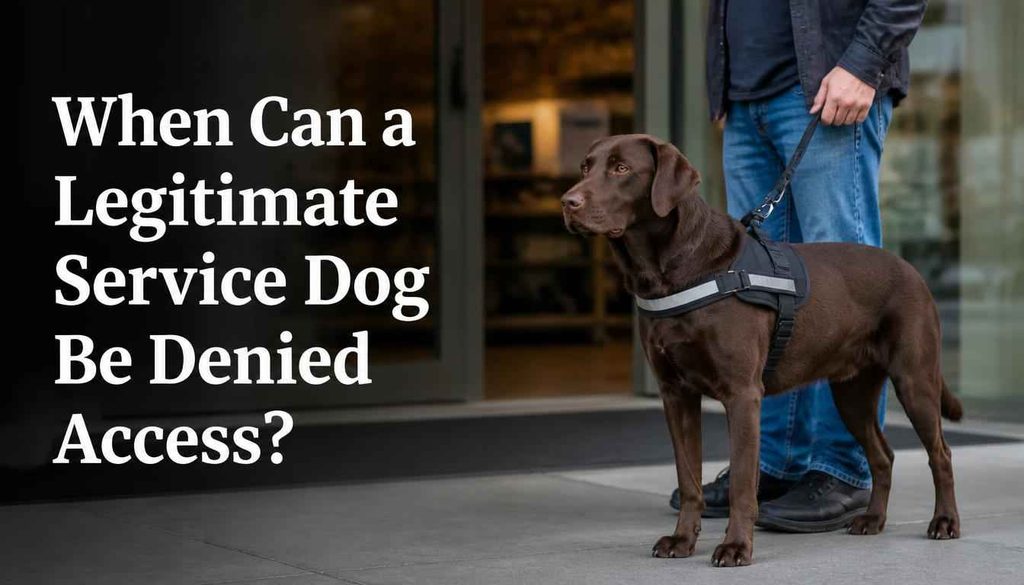
Under the ADA, a service dog may be excluded in limited circumstances, including when the dog is out of control and the handler does not take effective action, or when the dog is not housebroken.
For air travel, the rules can be different and include additional safety and behavioral considerations. Airlines may deny transportation when a service dog poses a direct threat, causes significant disruption, violates applicable safety requirements, or does not meet certain applicable transportation requirements.
If a service dog is properly excluded from a covered facility, the person should generally still be given the opportunity to obtain the goods or services without the animal.
What Individuals Can Ask About Your Service Dog
The ADA’s two permitted questions are about whether the dog is required because of a disability and what work or task the dog has been trained to perform.
You generally cannot ask a person to reveal their diagnosis, show medical records, produce a certification card, or demonstrate the dog’s task.
This protection matters because asking for unnecessary proof can expose people with disabilities to uncomfortable or discriminatory situations.
How to Deal with Fake Service Dogs
If you believe a dog may not be a legitimate service animal, stay calm. Your goal should be to protect safety and follow the law—not to publicly confront or embarrass the handler.
Contact the Authorities
If there is an immediate safety issue, follow your normal emergency procedures. For non-emergency concerns, a business should use its established policies and seek appropriate legal or management guidance.
State and local laws concerning misrepresenting an animal as a service animal can vary. Because penalties differ by location, avoid making broad claims about fines or criminal consequences without checking the applicable law.
Ask the Person to Leave
A business should not simply remove a dog because it lacks a vest or because the handler cannot produce paperwork.
If the dog is genuinely out of control and the handler does not regain control, or the dog is not housebroken, the ADA allows covered entities to exclude the animal. The person should still be offered access to the goods or services without the dog where required.
Ensuring Your Service Dog Success
If you are training a dog to become a service dog, focus on obedience, public behavior, reliability, and disability-related tasks. The dog should be comfortable around everyday distractions and able to respond consistently to its handler.
Training should also be realistic for the dog’s temperament and abilities. Not every dog is suited to service work, and success depends on the individual dog’s behavior, health, confidence, and ability to perform the required tasks.
If you are considering training your own dog, our guide on how to make your dog a service dog explains the process and important training considerations in more detail.
No More Fake Service Dogs
Learning how to spot a fake service dog does not mean questioning every dog you see. It means understanding the difference between legitimate service work, ordinary pets, emotional support animals, and genuinely disruptive behavior.
The strongest approach is simple: observe, don’t provoke; follow the law, don’t assume; and focus on behavior rather than appearance.
That approach protects businesses, the public, and—most importantly—people who genuinely depend on service dogs every day.
FAQs
How can you tell if a service dog is real?
Look at the dog’s behavior and the handler’s control rather than its vest or breed. A legitimate service dog should generally be trained to perform disability-related work or tasks and behave appropriately in public.
Can you touch a service dog?
It is best not to touch, pet, call, or distract a service dog without the handler’s permission. Even a friendly interaction can interrupt a dog while it is working.
Can a service dog be fake without a vest?
Yes, a dog can be a legitimate service dog without a vest. The ADA does not require service dogs to wear vests, patches, ID tags, or special harnesses.
Do service dogs need certification?
No. The ADA does not require service dogs to have a universal certification, registration, or license. Businesses generally cannot demand certification as a condition of entry.
Can you ask someone to prove their dog is a service dog?
Under the ADA, covered entities cannot demand documentation when the dog’s service status is not obvious. They may ask the two permitted questions about disability-related necessity and the dog’s trained work or task.
Can You Touch a Service Dog?
No, you should not touch or pet a service dog without the handler’s permission. Touching, calling, feeding, or distracting a working dog can interrupt an important task. The safest and most respectful choice is to let the dog focus on its handler unless the handler invites interaction.
Can any breed be a service dog?
Yes. The ADA does not restrict service dogs to particular breeds. Breed alone cannot establish that a dog is fake.
What is the biggest sign of a fake service dog?
There is no single guaranteed sign. Repeated uncontrolled, aggressive, or highly disruptive behavior can be a strong concern, but one unusual behavior should not automatically lead to an accusation.
How do you deal with fake service dogs?
Stay calm and avoid confrontation. If you operate a business, follow ADA requirements and your established procedures. If there is a genuine safety problem, use the appropriate local or emergency channels.
Can airlines ask for service dog documents?
Airline rules are different from ordinary ADA public-access rules. Under current DOT rules, airlines may require specific DOT service-animal forms in applicable circumstances, so travelers should check the airline’s current requirements.
Spotting fakes: what really matters
Knowing how to catch a fake service dog is really about knowing what to look for—and what not to assume. Poor control, repeated aggression, and serious disruptive behavior can raise legitimate concerns, but a missing vest, unusual breed, or invisible disability does not prove that a service dog is fake.
When in doubt, respect the handler’s privacy, avoid distracting the dog, and follow the ADA rules that apply to your situation. A careful, informed approach helps keep public spaces welcoming while protecting the people who genuinely rely on service dogs.



Pingback: Can Drug Dogs Smell Nicotine | The Facts About Sniffer Dogs