

Dogs can see much better than humans in low-light conditions, but they cannot see in complete darkness. Their tapetum lucidum, numerous rod cells, and larger pupils help them use available light efficiently. In pitch-black environments, dogs rely more on their hearing and strong sense of smell.
Ever wondered how your dog can spot movement in a dark room while you can barely see a thing? Their eyes have a few remarkable tricks that give them a natural advantage in low light.
Do Dogs Have Night Vision?
Yes, dogs have excellent low-light vision, often called dog night vision. However, this does not mean they can see when there is absolutely no light. Their eyes are designed to collect and use small amounts of available light more efficiently than human eyes.
So, do dogs have night vision in the same way a camera or night-vision device does? No. A dog still needs some light to form a visual image.
Dogs inherited these useful visual abilities from their wild ancestors, which were active around twilight. Being able to notice movement in dim conditions could help an animal find food, avoid danger, and move safely.
This is why your dog may confidently walk across a dim hallway while you reach for the light switch. Their ability to see in low light is also connected to how dogs perceive colors, which is different from human vision. You can learn more about how dogs see pink and other colors.
How Does Dog Night Vision Work?
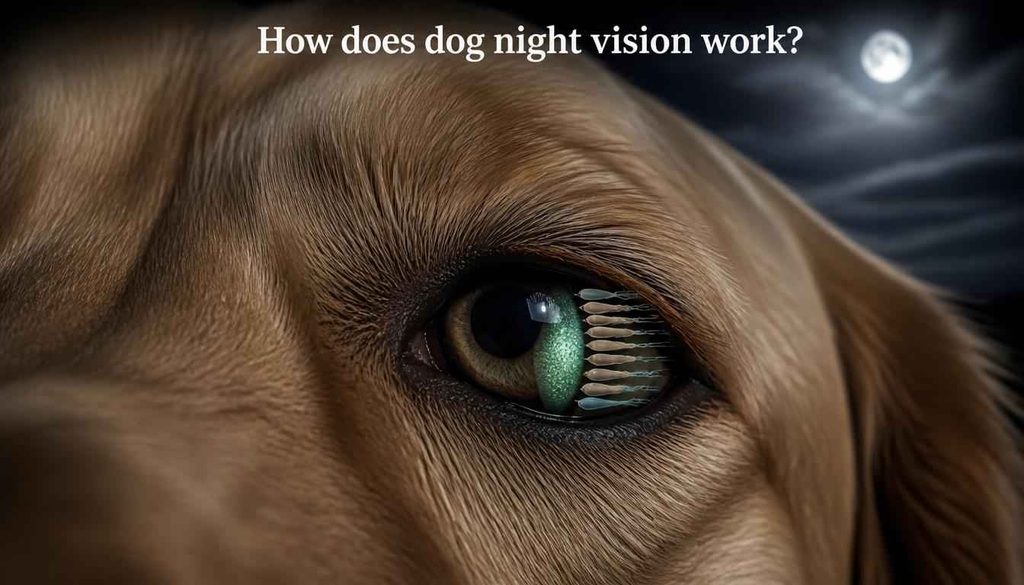
To understand how dogs see at night, it helps to look at what happens when light enters the eye.
Light first passes through the cornea and pupil. The lens then focuses that light onto the retina at the back of the eye. The retina contains photoreceptors called rods and cones.
Rods are especially sensitive to low levels of light and help detect movement and shapes. Dogs have more rods than humans, giving them an important advantage in dim environments.
Dogs also have a reflective structure called the tapetum lucidum behind the retina. Light that passes through the retina can be reflected back toward it, giving the light-sensitive cells another opportunity to detect it. This helps improve visual sensitivity in low light.
That combination explains much of canine night vision. The eyes gather available light, the rods respond strongly to it, and the tapetum helps make better use of light that might otherwise pass through the retina.
Dog Eye Anatomy
A dog’s eye has many of the same basic structures as a human eye, including the cornea, iris, pupil, lens, retina, and optic nerve.
The cornea is the clear outer surface that helps focus incoming light. Behind it is the iris, the colored part of the eye that controls pupil size. The pupil expands in dim conditions so more light can enter.
The lens further focuses light before it reaches the retina. The retina contains rods and cones that convert light into signals sent through the optic nerve to the brain.
The important difference for night vision is the way these structures work together. Dogs have many light-sensitive rods, and their eyes contain the tapetum lucidum, which enhances their ability to use available light.
Dogs also generally have a wider field of view than humans because their eyes are positioned more toward the sides of the head. The exact field varies between breeds.
Nocturnal Vision Advantages for Dogs
Dogs have several useful adaptations for seeing in dim light.
More rods: Rod cells are highly sensitive to low light and help dogs detect movement and general shapes.
Tapetum lucidum: This reflective layer gives incoming light another chance to stimulate the retina and contributes to the familiar eye shine seen at night.
Large pupils: Dogs can dilate their pupils widely, allowing more available light to enter the eye.
Strong motion detection: Dogs are particularly good at noticing movement, which is valuable when visibility is poor.
These features explain dog vision at night without suggesting that dogs can see in conditions where no light exists.
What helps a dog see at night?
Several parts of a dog’s visual system work together to make low-light vision effective. The most important are the rods, large pupils, and tapetum lucidum.
Rods help detect light, shapes, and movement. The pupil opens wider in dim surroundings, allowing more light into the eye. The tapetum reflects some light back through the retina, increasing the opportunity for photoreceptors to detect it.
This is also why a dog’s eyes may appear to shine when a flashlight or car headlight reaches them. The light is being reflected by the tapetum rather than being produced by the eye itself.
Color vision works differently. Dogs are not simply seeing a black-and-white world. Their color vision is more limited than ours, with dogs generally described as having dichromatic color vision. For example, you can also learn more about whether dogs can see purple and how color perception differs from humans.
Do Dogs See Better Than Humans at Night?
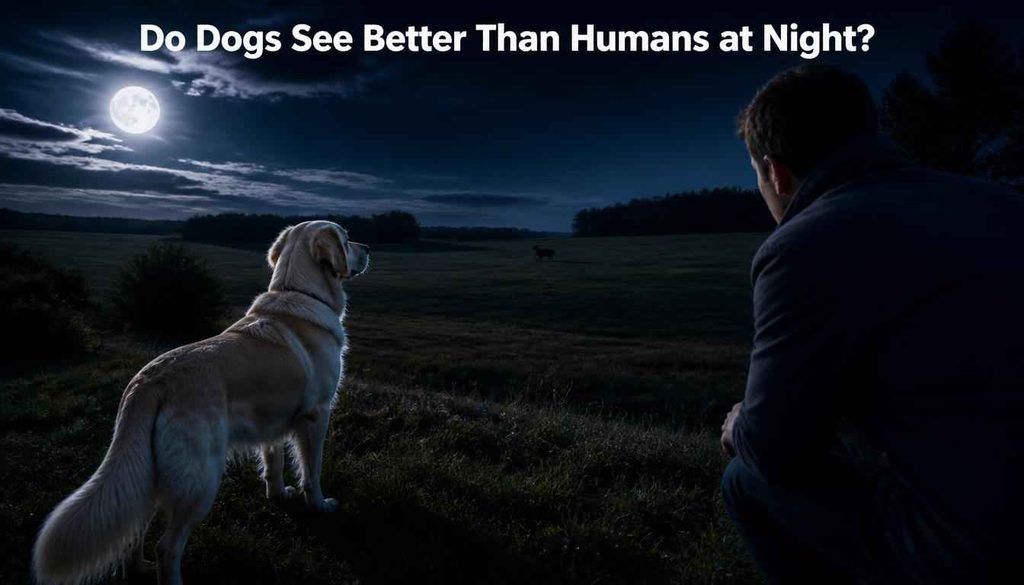
Yes. Dogs generally see better than humans in dim light, particularly around dusk, dawn, and other low-light situations. Their higher number of rods and reflective tapetum give them an advantage when there is not much light available.
So, how well can dogs see in the dark? They can detect shapes and movement in conditions where humans may struggle to see clearly. However, their advantage is strongest when there is at least some light available.
Dogs trade some visual detail and color discrimination for improved sensitivity to light and movement. This means your dog may notice a moving animal in a dim yard before you do, while you may be better at seeing fine details in good lighting.
Can Dogs See Better In the Dark Than Humans?
Yes, in low-light conditions, dogs generally have better vision than humans. Their eyes are especially good at collecting and using limited light, while their visual system is strongly tuned toward detecting movement.
This does not mean dogs have sharper eyesight overall. Human vision is generally better for fine detail and color discrimination. Dogs have a different set of strengths.
If you wonder what do dogs see at night, imagine a darker, less detailed scene in which shapes and movement stand out more strongly. A dog may not see every detail of a person standing across a dark yard, but it can be very good at noticing that something is there and moving.
This ability can be particularly useful for dogs that spend time outdoors, work in low-light environments, or naturally become alert to movement after sunset.
Do Dogs Need a Light on at Night?
Dogs do not necessarily need a nightlight to sleep or move around a normally dim home. However, they cannot see in complete darkness, so some available light can make navigation easier.
If a room is genuinely pitch black, your dog will not be able to visually identify objects simply because it is a dog. Vision requires light. Other senses, especially smell and hearing, can still help your dog navigate its surroundings.
So, do dogs need light to see at night? They need at least some light for vision, but they can make much better use of low levels of light than humans.
A small nightlight can be useful if your dog regularly moves around an unfamiliar or dark area at night, especially if the dog is older or has an eye condition. If you notice sudden difficulty navigating in darkness, bumping into objects, or other changes in vision, a veterinary examination is a smart next step.
Can Dogs See Better Than Cats at Night?
No. Cats generally have an advantage over dogs when it comes to low-light vision. Both animals have adaptations that help them function in dim conditions, including a tapetum lucidum, but cats are particularly well adapted for nighttime activity.
This answers the common question, “Can dogs see in the dark like cats?” Dogs can see very well in low light, but cats are generally better suited to extremely dim conditions.
Dogs should therefore not be thought of as completely nocturnal animals. Their visual system is excellent for detecting light and movement, but their abilities differ from those of cats. If you’re also interested in how dogs perceive different colors, you can learn more about whether dogs can see orange.
Can Dogs See Glow-in-the-Dark Objects?
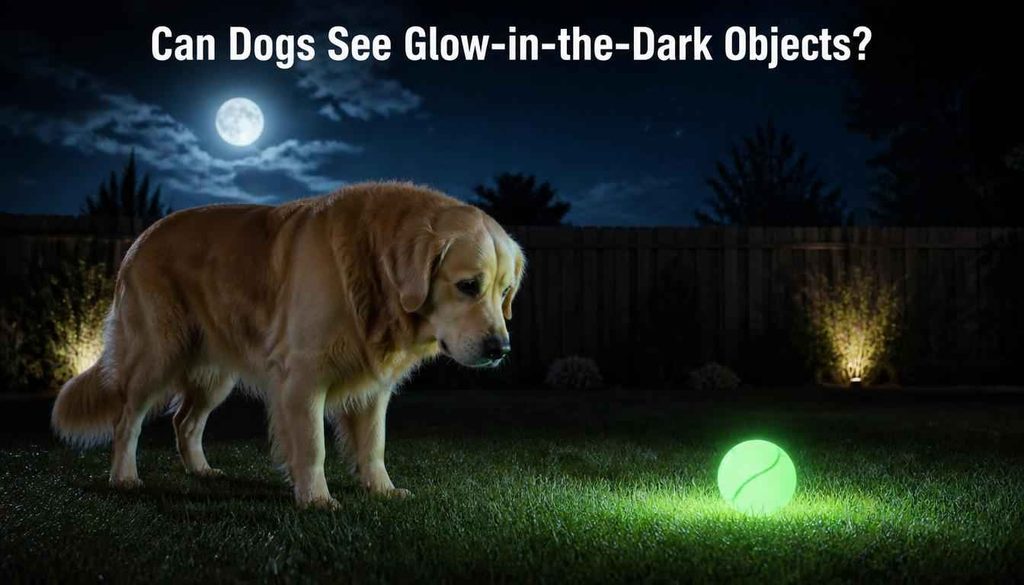
Yes, dogs can likely see glow-in-the-dark objects when the object produces enough visible light. However, your dog may not perceive the object’s color in the same way you do.
The important point is that the glow itself provides light that the dog’s visual system can detect. Because dogs have different color vision from humans, the object may appear different to them.
For toys used at night, visibility can be more important than color alone. A bright, high-contrast toy that is easy to detect against its surroundings can be easier for your dog to find.
Understanding canine color vision can also help when choosing toys. Dogs can see some colors, but their color range is narrower than ours. For example, you can learn more about their ability to see yellow when choosing colors for toys and training objects.
6 facts about dog eye-sight
1. Dogs see better in low light than humans. Their eyes contain many light-sensitive rods and a tapetum lucidum that helps them use available light efficiently.
2. Dogs cannot see in absolute darkness. Even a highly adapted canine eye needs some light to create a visual image. Their other senses can still help them move around when visibility is extremely poor.
3. Dogs are excellent at detecting movement. Their visual system is particularly useful for noticing moving objects, especially in dim conditions.
4. Dog eyes can glow at night. That familiar green, yellow, orange, or blue eye shine comes from light reflecting off the tapetum lucidum. The appearance can vary between dogs and circumstances.
5. Dogs do not see the world only in black and white. Their color vision is limited compared with humans, but veterinary sources describe dogs as having a form of dichromatic color vision rather than complete color blindness.
6. Dogs have different visual strengths from humans. They are better adapted for low-light sensitivity and movement detection, while humans generally have advantages in fine detail and color discrimination.
FAQs
What do dogs see in the dark?
Dogs generally see a dim scene with shapes and movement more easily than humans do. Their vision is not equivalent to human night-vision equipment, and details can be less sharp.
What does a dog see at night?
A dog can detect available light, movement, and general shapes in a dark environment. Colors and fine details are less important to its night-adapted visual system.
Can a dog see in the dark?
Yes, a dog can see well in low light. However, some light must be present because the eye cannot form a visual image in absolute darkness.
Can dogs see in complete darkness?
No. Can dogs see in complete darkness is a common question, but even their highly adapted eyes require some light. When there is none, dogs rely more heavily on hearing, smell, and other senses.
Can dogs see in the pitch black?
Not visually. If a room is truly pitch black, there is no light for the retina to detect. Your dog may still move around using its other powerful senses.
Can dogs see in total darkness?
No. Can dogs see in total darkness is different from seeing in very low light. Dogs are excellent at using small amounts of available light, but they cannot see without light.
How far can dogs see in the dark?
There is no single distance that applies to every dog. Breed, eye health, available light, object size, movement, and surroundings all affect how far a dog can detect something.
How much can dogs see in the dark?
Dogs can see enough in low light to detect shapes and movement better than humans in many situations. Their ability decreases as available light approaches zero.
Dog Eyesight At Night?
Dog eyesight at night is stronger than human vision. Dogs use sensitive rods and the tapetum lucidum to see shapes and movement in dim light.
Do Dogs Have Good Night Vision?
Yes, dogs have good night vision. Their eyes collect available light efficiently, helping them see shapes and movement better than humans in low-light conditions.
How Do Dogs See At Night?
Dogs see at night by using sensitive retinal rods, large pupils, and the tapetum lucidum to collect, reflect, and use available light more effectively.
Do Dogs See Better In The Dark?
Yes, dogs see better in the dark than humans when some light is available. Their eyes are specially adapted for detecting movement and shapes in dim conditions.
The bottom line: can dogs see in the dark
Dogs have an impressive natural advantage in low-light environments. Their large pupils, abundance of rods, and tapetum lucidum help them collect and use limited light, making nighttime movement easier than it is for humans.
But there is one important limit: dogs cannot see in absolute darkness. They need some light to see, while their excellent hearing and powerful sense of smell can help them when vision becomes less useful.
Understanding your dog’s eyesight can make nighttime walks, play, and home routines safer and more enjoyable. If your dog suddenly struggles to navigate at night or shows a noticeable change in vision, don’t assume it is normal night behavior—ask your veterinarian to check the eyes.
Content trust note: This article is based on established veterinary and canine-vision information from sources including the Merck Veterinary Manual, VCA Animal Hospitals, and the American Kennel Club.