

Dogs can see red objects, but they do not perceive red like humans. Because dogs have dichromatic vision, red may appear dull, dark, brownish, or grayish. They rely on brightness, contrast, shape, and movement to recognize red objects, while blue and yellow are easier to distinguish.
Ever wondered what red looks like to your dog? Learn how canine eyes process red, which colors stand out, and why toys can appear differently.
How Dogs See the Color Red
Dogs have two types of cone cells that help them distinguish colors. Humans typically have three types, which allows us to perceive a wider range of colors. Because dogs lack the type of cone that is most sensitive to longer wavelengths associated with red, they have difficulty separating red from some other colors.
How Do Dogs See Red? Instead of seeing a bright, vivid red like a person might, a dog may perceive the object as a darker or less distinct shade. The exact appearance can vary depending on lighting, brightness, background, and the specific object.
A red ball sitting on a light-colored floor may still be easy for a dog to notice because of its shape and contrast. However, the same ball sitting in an environment with similar brightness may be harder to locate.
For dogs, color is only one part of vision. Movement, contrast, size, and familiarity can all help them identify an object.
Internal link placement: Add your 1st internal URL here naturally in this section.
What Does Red Look Like to a Dog?
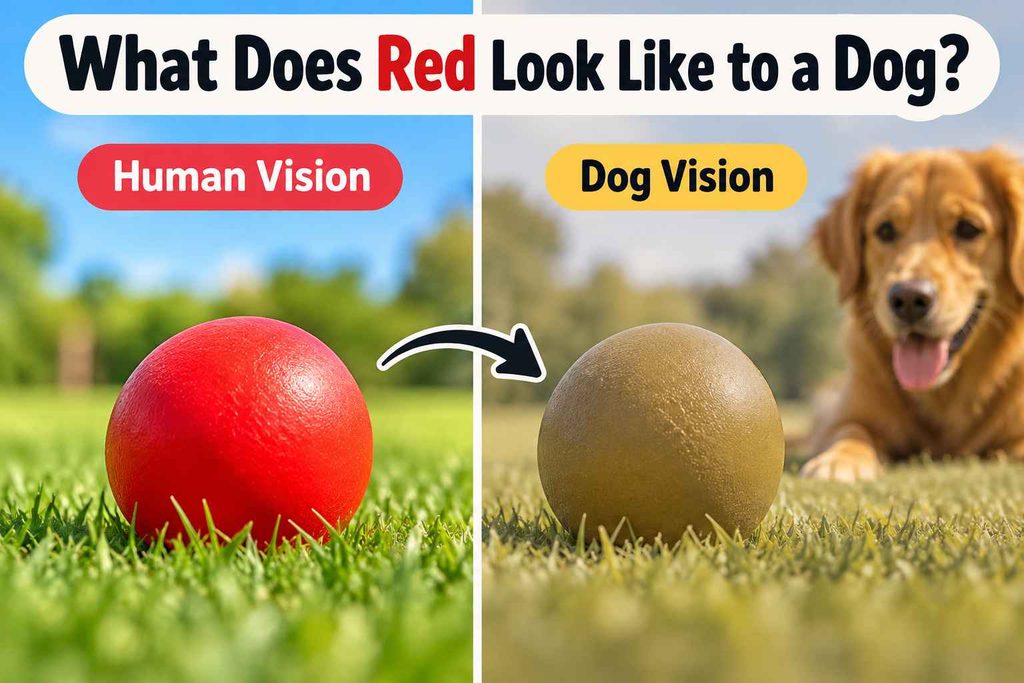
There is no single shade that can perfectly describe how every dog perceives red. In general, red can appear less vivid and may be perceived as a dark, muted, brownish, grayish, or yellowish-looking shade depending on the surrounding colors and lighting.
This is because canine color vision does not separate red from other longer-wavelength colors as well as human vision does. A bright red toy may therefore lose much of the visual impact it has for us.
That does not mean your dog cannot see the toy. Your dog may notice its outline, movement, texture, brightness, and position. If you throw the toy across the yard, movement can immediately attract your dog’s attention even if the color itself is difficult to distinguish.
The background also matters. A red toy on a pale floor can have strong brightness contrast, while a similar-colored object against a darker or visually busy background may be harder to notice.
What Colors Can Dogs See?
Dogs are not completely color blind. Their eyes can distinguish certain colors, with blue and yellow generally being easier for them to separate than red and green.
The simplest answer is blue, yellow, and various shades that fall within or around those parts of the visible spectrum. Dogs can also see differences in brightness, which helps them recognize objects even when two colors look similar.
Here is a simple comparison:
| Color | How Dogs Generally Perceive It |
| Blue | Relatively easy to distinguish |
| Yellow | Relatively easy to distinguish |
| Red | Difficult to distinguish clearly |
| Green | Difficult to distinguish from some other colors |
| Orange | Can appear less distinct |
| Purple | Often perceived closer to blue |
The important point is that canine vision is not simply a weaker version of human vision. Dogs have visual abilities suited to their needs, including strong motion detection and useful vision in lower-light conditions.
Can Dogs See Red and Green the Same Way?
Can Dogs See The Color Red And Green as separate colors? Not as clearly as most humans can. Red and green can be difficult for dogs to distinguish because their color vision is based on two cone types rather than three.
This is one reason a red ball lying in green grass may not provide the strong color contrast that a person expects. To a human, the red ball may stand out immediately against the grass. To a dog, the difference in color can be much less obvious.
However, dogs can still locate objects through other visual clues. A moving ball can be easy to follow because dogs are very good at detecting movement. Shape, brightness, smell, and sound may also help.
So, if your dog finds a red toy quickly, that does not necessarily mean your dog sees red exactly as you do. Your dog may simply be using several other senses and visual cues to find it. For another example of how dogs perceive a color differently from humans, see our guide to how dogs see orange.
Can Dogs See Red Toys?
Yes, dogs can see red toys, but the color itself may not stand out as strongly as it does to a human. A red toy can still be perfectly useful for playing, chewing, fetching, or training.
Can dogs see red toys clearly? They can see the physical object, but its red color may look muted or less distinct. The toy’s shape, movement, brightness, and contrast can make a much bigger difference.
For example, imagine throwing a red rubber ball across a yard. Your dog may track the ball as it moves through the air and then locate it after it lands. The dog does not need to identify the color as “red” to find it.
If you are choosing a toy specifically for outdoor games, blue or yellow toys may offer stronger visual contrast for many dogs. This can be especially useful when the toy is thrown onto grass, dirt, or another visually busy surface.
Red toys are not bad for dogs, though. If your dog already enjoys a particular red toy, there is no reason to remove it simply because canine color vision differs from ours.
Are Dogs Red-Green Color Blind?
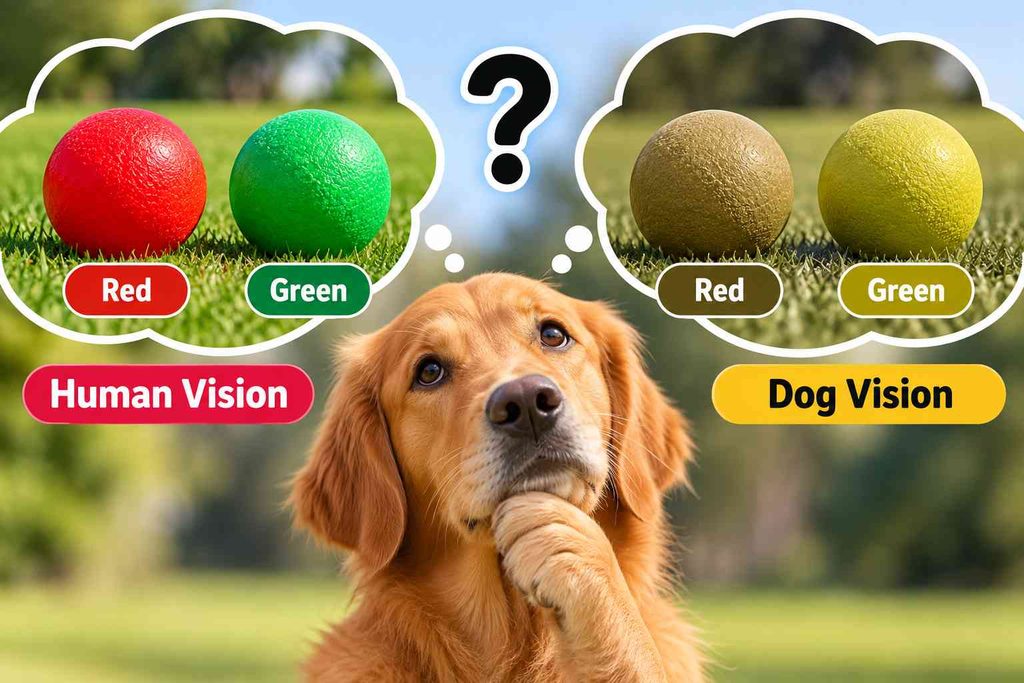
The phrase are dogs red green color blind is commonly used to describe canine color vision, but it needs some clarification. Dogs have a form of color vision that is often compared with human red-green color blindness because they have difficulty distinguishing some red and green shades.
However, canine vision is not exactly identical to the vision of a human with red-green color blindness. Dogs naturally have two main types of cone cells, while humans generally have three.
This means dogs can see some colors but have a narrower range of color discrimination. Blue and yellow are generally easier for them to distinguish, while certain combinations involving red and green can appear much more similar.
Color is also only one part of what dogs use to understand their surroundings. Their eyes are highly useful for detecting movement, while their sense of smell and hearing provide additional information. For more information about another color in the canine visual range, you can read our guide on how dogs see purple.
Can Dogs See Red Light?
Dogs can detect light in the red portion of the visible spectrum, but their ability to perceive it as the color red is different from human color perception.
A red light may not appear to your dog as the same vivid red that you see. Its brightness can still be noticeable, however, especially when it contrasts strongly with a darker environment.
This distinction is important when discussing red laser lights, electronic indicators, or illuminated toys. Seeing a light source and identifying its color are two different things.
Dogs can also be sensitive to movement, so a moving light may attract their attention even when its color is not particularly meaningful to them.
Are Dogs Color Blind?
Calling dogs “color blind” can be misleading. Dogs are not unable to see color. They simply see a smaller range of colors than humans.
Their two-cone visual system allows them to distinguish some colors effectively while making other color differences much harder to notice.
Humans with typical vision can separate red, green, blue, orange, purple, and many other shades. Dogs have a more restricted system, so several colors that look clearly different to us can appear similar to them.
This difference does not mean dogs have poor vision overall. In some situations, their visual abilities are especially useful. Dogs are good at detecting movement and can function well in lower-light conditions than humans.
Their vision also works together with their extremely strong sense of smell and hearing. A dog does not need to identify the exact color of an object to understand what it is or where it is.
What Other Colors Are Difficult for Dogs to See?
Dogs have more difficulty separating colors that fall into ranges their two cone types do not distinguish well. This is why some combinations that look dramatically different to humans may appear much closer to each other to a dog.
Red, green, and orange can be less visually distinct than blue or yellow. The appearance also changes according to brightness and the background behind an object.
For example, a green toy placed on grass may blend into its surroundings more than a bright blue toy. Similarly, an orange object may not have the same strong color contrast that it has for human eyes.
This does not mean dogs are visually impaired. Their eyes are adapted for a different range of visual information, and they can rely heavily on movement and contrast.
Why Do Dogs Still Find Red Objects?
A dog does not need to identify an object’s exact color to recognize it. Several other visual and sensory clues can make an object easy to find.
Dogs can use:
- Movement: A moving object can immediately attract attention.
- Brightness: A brighter object can stand out from a darker background.
- Shape: Familiar shapes help dogs recognize toys.
- Contrast: Strong differences between an object and its surroundings make detection easier.
- Smell: Dogs can use scent to locate familiar objects.
- Sound: Toys that squeak or make noise provide another useful clue.
This explains why a dog may have no problem finding a red toy even though the color itself is not especially easy for the dog to distinguish.
What Color Is Best for Dog Toys?

Blue and yellow are generally practical choices when you want a toy that is easier for a dog to distinguish visually. This can be particularly helpful during outdoor games.
The background should also influence your choice. A toy that contrasts strongly with grass, sand, carpet, or snow can be easier to locate.
For example, a blue toy may be easier to spot against green grass than a red or green toy. A yellow toy can also provide useful contrast in many outdoor environments.
Still, color should not be the only factor when choosing a toy. Durability, size, material, safety, and your dog’s individual preferences are equally important.
If your dog loves a red ball and can easily find it, there is no need to replace it simply because another color might be easier to distinguish.
How Does Dog Vision Differ From Human Vision?
Human and canine eyes share many basic structures, but the way they process color and light is different.
Humans generally have three types of cone cells, allowing us to distinguish a broad range of colors. Dogs have two main types, giving them a narrower color range.
Dogs also have visual adaptations that can help them in dim conditions. Their eyes contain more rod cells than humans, and structures within the eye can contribute to their ability to detect light efficiently.
Dogs are also highly responsive to movement. This is useful for an animal that naturally depends on detecting moving objects and changes in its surroundings.
So while humans generally have an advantage in detailed color discrimination, dogs have other visual strengths that are valuable in everyday life.
When Should You Worry About Changes in Your Dog’s Vision?
Normal canine color vision should not suddenly change. If you notice a significant difference in how your dog navigates familiar surroundings, it is worth paying attention.
Signs that may indicate a vision problem include:
- Bumping into furniture or walls
- Hesitating on stairs
- Difficulty finding familiar objects
- Becoming nervous in unfamiliar lighting
- Trouble navigating at night
- Cloudiness or unusual changes in the eyes
- Sudden changes in behavior around familiar surroundings
A sudden change in vision deserves prompt veterinary attention. Eye problems can have many different causes, and only a veterinarian can determine whether a change is related to an eye condition, aging, injury, or another health issue.
Frequently Asked Questions About Dogs See Red
Can Dogs See Red?
Yes. Dogs can see objects that are red, but they do not perceive the color in the same vivid way humans typically do. Red may appear muted or less distinct because dogs have dichromatic color vision.
What Does Red Look Like To Dogs?
Red may appear darker, muted, brownish, grayish, or somewhat yellowish depending on the lighting and surrounding colors. Dogs can still identify red objects using shape, movement, brightness, contrast, smell, and other clues.
What Colors Can Dogs Not See?
Dogs do not have the same broad color range as humans. They have difficulty distinguishing many red and green shades, while blue and yellow are generally easier for them to identify.
Are Dogs Red Green Color Blind?
Dogs are often described as having red-green color blindness because their two-cone vision makes some red and green shades difficult to distinguish. However, their vision is not exactly the same as human red-green color blindness.
How Do Dogs See Red?
Dogs perceive red through their two-cone visual system, which does not separate longer-wavelength colors in the same way human vision does. Red therefore appears less vivid and can be harder to distinguish from certain other colors.
The bottom line: can dogs see the color red
Dogs can see red objects, but they do not experience red exactly as humans do. Their dichromatic vision gives them a narrower range of color perception, with blue and yellow generally being easier to distinguish.
A red ball can still be easy for your dog to find because dogs use much more than color. Movement, brightness, shape, contrast, smell, and sound all help them understand their surroundings.
If you are buying toys specifically for visibility, blue and yellow can be useful choices, especially outdoors. But there is no reason to avoid red toys if your dog enjoys them and can easily find them.
The biggest takeaway is simple: dogs are not limited to seeing the world in black and white. They see colors differently from us, and their vision is well suited to the way they interact with their environment.
For readers who want to explore canine color vision further, you can also learn how dogs see yellow and compare it with the way they perceive red.



Pingback: Can Dogs See Pink | A Guide to Canine Color Vision