

When people ask me what is the most dangerous dog in the world, I start with an uncomfortable truth: no single breed holds the title, and the honest answer changes depending on where you live. In the United States, pit bull-type dogs dominate the fatality records.
In Britain, four breeds are banned outright. In the Caucasus mountains, a 200-pound livestock guardian wouldn’t notice them. So which dogs are truly the most dangerous worldwide? I dug into global bite statistics, breed-ban laws in more than ten countries, and what veterinarians actually say.
“No single breed is the most dangerous dog in the world — but a large, powerful, poorly socialized dog in the wrong hands is the most dangerous combination in the world.”
The Short Answer: No Single Breed Wins This Title
Here is the honest version first. The AVMA, the CDC, and veterinary researchers all agree on one thing: breed alone is a poor predictor of whether an individual dog will be dangerous.
The AVMA calls it inappropriate to predict a dog’s aggression from breed alone, and the CDC stopped tracking bite fatalities by breed after its 2000 study because witness and media breed identification is unreliable.
That does not make the question pointless: size, strength, breeding history, and how a breed is typically raised all matter. The real question is which breeds combine the physical tools to cause severe harm with the highest risk of actually doing it.
What the Fatality Numbers Actually Say
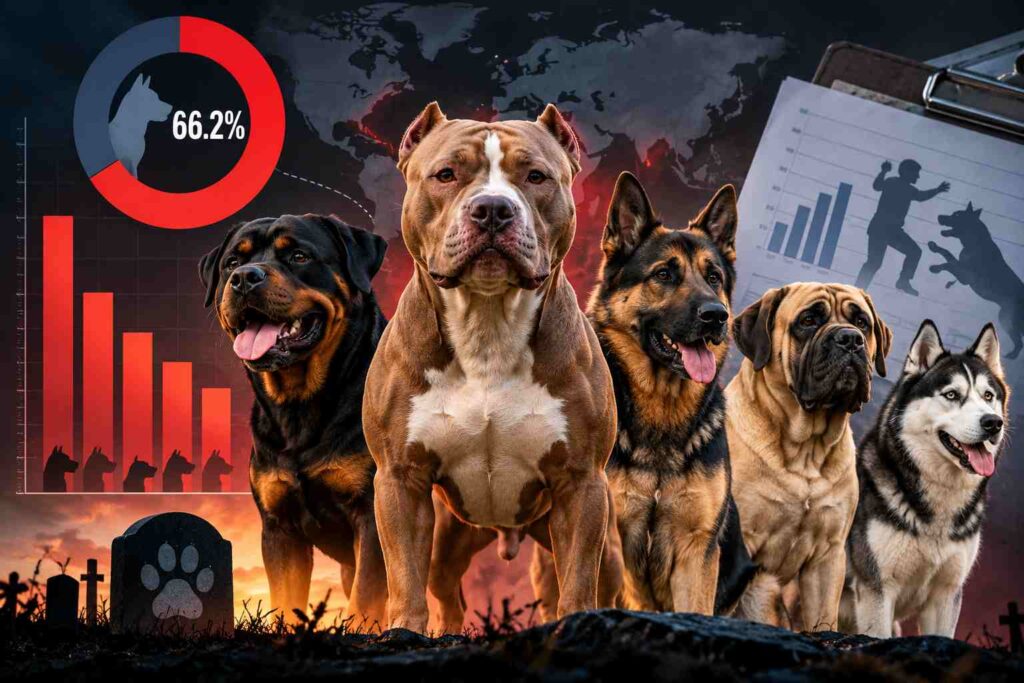
Let’s look at the hard numbers first — this is where most rankings get their data. Dangerous dog statistics need careful reading, because almost every headline number comes with a catch.
The most cited source for fatal dog attacks by breed is a 15-year U.S. tracking database (2005–2019) covering 523 dog-bite deaths:
| Breed group | Deaths | Share |
|---|---|---|
| Pit bull-type dogs | 346 | 66.2% |
| Rottweiler | 52 | 9.9% |
| Mixed breed | 27 | 5.2% |
| German Shepherd | 22 | 4.2% |
| Mastiff / Bullmastiff | 18 | 3.4% |
| American Bulldog | 17 | 3.3% |
| Husky | 14 | 2.7% |
| Labrador Retriever | 9 | 1.7% |
| Boxer | 7 | 1.3% |
| Doberman Pinscher | 6 | 1.1% |
Two things stand out: pit bull-type dogs account for roughly two-thirds of deaths, and over 80 breeds and mixes have been implicated since 2016 — including Labradors and huskies.
Why these numbers need a warning label
- Nobody knows how many dogs of each breed exist. With no national registry, a bite count can never become a bite rate — the AVMA says so directly. Popular breeds always top raw-count lists, the way best-selling cars top accident statistics.
- Breed identification is unreliable. A peer-reviewed JAVMA study of 256 fatalities found breed could be validly determined in only 18% of cases, and over 40% of media breed reports conflicted with animal control’s own identification.
- Genetics barely explains behavior. A genomic study in the journal Science found breed explains only about 9% of behavioral variation between dogs.
- Ownership factors dominate. In that JAVMA study, 84% of the dogs in fatal attacks had not been spayed or neutered. Chaining, isolation, and abuse show up far more consistently than any breed label.
So the numbers are real, but they describe which dogs get involved in the worst incidents — not which dogs are inherently dangerous.
The Breeds That Top Danger Lists Worldwide
The breeds on nearly every top dangerous dogs list are ranked by fatalities, bite force, or government bans — and no two lists fully agree. Still, the same names keep appearing, and pit bull-type dogs top nearly every tally of the world’s deadliest dog breeds.
Pit bull-type dogs
The pit bull dangerous dog label comes down to physics and history: these dogs — the American Pit Bull Terrier, American Staffordshire Terrier, Staffordshire Bull Terrier, and their mixes — were bred for bull-baiting and dog fighting, selecting for strength, pain tolerance, and a tenacious bite-and-hold style.
In fatality tracking, pit bull-type dogs are recorded as the most lethal dog breed category — about two-thirds of U.S. dog-bite deaths between 2005 and 2019. But two things inflate that number: “pit bull” is a visual category, not one breed, and DNA studies show eyeball breed guesses are wrong most of the time; and pit bull types are hugely popular with owners who want an intimidating dog and keep it chained, isolated, and unsocialized.
Research on american pit bull terrier aggression keeps landing in the same place: the problem isn’t that every dog is dangerous, but that when things go wrong with a powerful terrier, the damage is catastrophic.
Rottweilers
The rottweiler dangerous breed reputation has two sides, both partly true. Rottweilers were bred as cattle-driving and guard dogs: confident, territorial, immensely strong.
They sit second in the fatality table at about 10% and second in many hospital studies of severe bites — but they are also one of the most popular large breeds on earth, which guarantees high raw numbers.
The guardian instinct that makes them loyal protectors is exactly what goes wrong without early socialization and firm training. Be honest about whether you have the time and experience for serious training before choosing one.
The giant guardians the world actually bans
Beyond the two headliners, the world’s restriction lists are dominated by giant guardian and fighting breeds most Americans have never met:
- Caucasian Shepherd: Bred to fight wolves and bears, these 110–220-pound dogs make life-or-death decisions without human guidance — fiercely loyal to family, deeply suspicious of strangers.
- Fila Brasileiro: Brazil’s mastiff, bred to hunt big game and guard cattle; its distrust of strangers is so defining the breed standard accepts it. Banned in the UK, Norway, and others.
- Dogo Argentino: Argentina’s big-game hunter — athletic, fearless, banned in the UK, Australia, and others.
- Cane Corso: Italy’s intensely territorial mastiff, on restriction lists across Europe.
- Japanese Tosa: Japan’s purpose-bred fighting dog — rare, quiet, over 200 pounds, banned in the UK, Ireland, Australia, and others.
The real guard dog breeds risks are the mismatch between a dog’s instincts and a suburban backyard. Many territorial dog breeds were developed to distrust strangers on sight, and that wiring does not switch off in a neighborhood.
These breeds need expert owners, serious containment, and lifelong training. For contrast, the giant Newfoundland — a water breed with webbed feet bred for rescue — rarely appears on any ban list, which shows how much a breed’s original job matters.
Bite Force: The Number Everyone Quotes
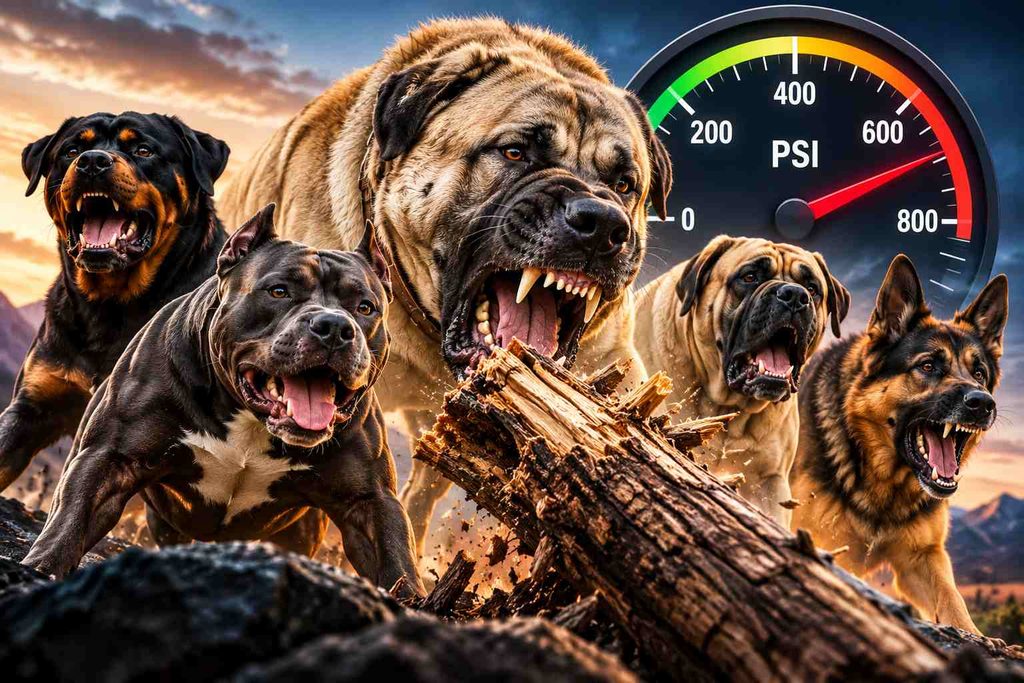
The strongest dog bite force is usually credited to the Kangal, a Turkish livestock guardian, at a widely reported 743 PSI — ahead of the Doberman, English Mastiff, and Rottweiler in online rankings. For the full breakdown, see my guide to the strongest bite force rankings.
But treat these numbers with skepticism. Research in the Journal of Anatomy found bite force is a function of body size and skull dimensions, not breed — big dogs bite harder because they are big. (The “locking jaws” pit bull myth is exactly that: no breed has a locking jaw.)
And online PSI figures come from non-standardized tests, so cross-site comparisons are shaky. What bite force does tell you is simple: once a very large dog bites seriously, the outcome is far worse than a small dog’s bite.
Which Countries Ban or Restrict These Breeds
This is where the “world” in the question earns its place. Among the most feared dog breeds worldwide, the same names repeat across ban lists — but how strictly, and which breeds, changes by country:
| Country / Region | Banned or restricted breeds |
|---|---|
| United Kingdom | Pit Bull Terrier, Dogo Argentino, Japanese Tosa, Fila Brasileiro, XL Bully (1991 Act) |
| Australia | Pit bull breeds, Dogo Argentino, Fila Brasileiro, Japanese Tosa, Presa Canario, wolf hybrids |
| Turkey | APBT, AmStaff, Dogo, Fila, Tosa, American Bully (since 2021) |
| UAE | Pit bull types, Dogo Argentino, Fila, Tosa Inu, Rottweiler, Doberman, Presa Canario, wolfdogs (import ban) |
| Taiwan | Six breed types incl. pit bull types, Tosa, Dogo, Fila — registration, muzzle, leash required |
| France | Category 1 (pit bull types, Tosa, Boerboel) banned from import; Rottweilers heavily restricted |
| Spain | Pit bulls, Rottweilers, Dogo, Fila, Tosa, Akita — registration, insurance, fitness test required |
| Canada | No national ban; Ontario bans pit bull types province-wide |
| United States | No federal ban; hundreds of local rules, many recently repealed |
Notice the pattern: governments keep banning the same small club of breeds, yet bite deaths have not clearly fallen where bans were tried — because the owners who create dangerous dogs simply switch to the next unrestricted powerful breed.
The Small-Dog Surprise
Here is the twist most rankings bury: measured by aggression instead of damage, the scariest breeds are tiny. A 2008 study surveying thousands of owners found dachshunds and Chihuahuas rated the most aggressive of all breeds toward almost everything — strangers, owners, and other dogs.
Beagles and cockers scored highest toward their own owners; pit bulls scored above average toward other dogs, but not strangers.
If you define “dangerous” by how often a dog snaps, the title of most aggressive dog breed might go to the humble dachshund. Even wiener dogs, those beloved sausage-shaped companions, rank near the top for owner-directed snapping.
Nobody fears them for one reason: physics. A 12-pound dog cannot do what a 120-pound dog can, and we excuse growling we would never accept from a Rottweiler.
Aggressive Is Not the Same as Dangerous
This is the most misunderstood idea in the whole debate. An aggressive dog breeds list answers a different question than a dangerous-breeds list: aggression is the likelihood of hostile behavior (growling, snapping, lunging), while dangerousness is the capacity to cause severe harm when it happens.
A Chihuahua can be extremely aggressive and essentially harmless; a Caucasian Shepherd can be perfectly calm and still lethal in one bad moment, purely through size and power.
Of all the world’s aggressive canine species, the domestic dog causes virtually all recorded bites — which says more about proximity than temperament. Rankings mash “which dogs bite most?” and “which dogs can do the most damage?” into one list, and the answers look nothing alike.
High-Risk Breeds as Family Pets
No honest discussion of dangerous family dogs can skip this: most fatal attacks happen at home, and most victims are children bitten by a familiar dog. High risk dog breeds are a poor match for first-time owners, busy families, or anyone wanting a low-maintenance pet.
Labels like unpredictable dog breeds usually describe under-socialized individuals, not bloodlines — but with a giant guardian, even a “usually sweet” dog having one bad moment can be a tragedy. With small children, I recommend gentle, well-reviewed small breeds for families over any dog chosen for intimidation.
Breeds like cavapoo dogs stay popular precisely because they pair a friendly temperament with a manageable size.
Powerful breeds can still be family dogs — but the margin for error is razor-thin: professional training, early and ongoing socialization, secure fencing, spaying or neutering, and never leaving a large dog unsupervised with small children are non-negotiable.
How to Stay Safe Around Powerful Dogs
Lethal dog bites are extremely rare — roughly one death per tens of millions of dog-human interactions. Still, know the basics: never approach an unfamiliar large dog, especially one chained, fenced, or guarding property.
Teach children not to hug strange dogs, disturb a sleeping or eating dog, or run from a dog. If a large dog charges, stay still and avoid eye contact; if knocked down, curl up, cover your ears and neck, and stay still. Spay or neuter your dog — 84% of dogs in fatal attacks were intact — and respect local laws on muzzles, leashes, and registration.
Frequently Asked Questions
1. What dog breed bites the most?
There is no reliable answer to that question. The AVMA states a true per-breed bite rate cannot be calculated, because breed populations are unknown and bite-report breed IDs are often wrong. Small breeds score highest for aggression in surveys, while large breeds cause the most severe injuries.
2. Are pit bulls banned in any countries?
Yes — in the UK, Australia, Turkey, the UAE, Taiwan, France, Ontario, and hundreds of U.S. cities and counties. Spain and others use registration, insurance, and muzzle rules instead of outright bans.
3. Which dog has the strongest bite force?
The Kangal, a Turkish livestock guardian, is usually credited with the strongest bite force at a widely reported 743 PSI — though researchers note these figures come from non-standardized tests.
4. Are Rottweilers good family dogs?
A well-bred, well-trained, and properly socialized Rottweiler can be a loyal, gentle family dog. But the breed is powerful, territorial, and demanding to raise, so it suits experienced owners who commit to serious training.
5. What makes a dog breed “dangerous”?
A breed is usually called dangerous based on physical power, breeding history, fatality statistics, and government restrictions. Researchers stress that temperament depends far more on training, socialization, and ownership than on breed.
6. Which country has banned the most dog breeds?
There is no official count, but Australia, the UAE, Turkey, and the UK are among the strictest, each banning or restricting roughly 5–11 breed types. Always check current law before traveling with a dog.
7. Do breed-specific bans actually reduce dog attacks?
The evidence is weak: bans target the breed instead of the cause — irresponsible ownership — and owners who want an intimidating dog simply switch to the next unrestricted powerful breed.
8. Is a wolfdog more dangerous than a pit bull?
Wolfdogs are generally considered higher-risk because they combine a wolf’s size, strength, and predatory instincts with far less predictability around people. Pit bull-type dogs were bred to work closely with humans, which is why most are sociable family pets.
9. What should I do if an aggressive large dog approaches me?
Stay calm and still, avoid direct eye contact, and keep your hands at your sides. Back away slowly; if knocked down, curl into a ball and cover your ears and neck until the dog loses interest.
10. Can any dog become dangerous without proper training?
Yes. Any dog — from a Chihuahua to a Cane Corso — can develop dangerous behavior without proper training and socialization. The difference is consequence: an untrained small dog may nip, while an untrained 150-pound guardian can kill.
The Most Dangerous Dog Is the One Nobody Trained
So, what is the most dangerous dog in the world? After the fatality data, bite-force charts, and a dozen countries’ ban lists, my answer is this: no breed owns the title, but a profile owns the risk — a large, powerful, intact, under-socialized dog kept in isolation by an owner who wanted intimidation more than companionship. That is good news, because the danger is preventable: choose a breed that fits your experience, socialize and train it properly, spay or neuter it, supervise it around children, and respect local laws. Still deciding? Start with breeds known for gentleness, not headlines.