
Turkey tail mushroom (Trametes versicolor) may support immune health in dogs through compounds such as beta-glucans and PSP. It has been studied in dogs with hemangiosarcoma, but evidence is mixed, so it should be used as supportive care—not as a replacement for veterinary cancer treatment.
Discover how turkey tail mushroom may support your dog’s immune health, what the research really shows, and how to use it safely with veterinary guidance.
What is Turkey Tail?
Turkey tail is a functional mushroom called Trametes versicolor. It contains compounds such as beta-glucans, PSP, and PSK that have attracted scientific interest because of their effects on immune activity. Today, it is commonly discussed as one of several medicinal mushrooms for dogs, particularly when owners are looking for supportive care.
The important point is that “natural” does not automatically mean effective or risk-free. The same applies to common ingredients such as sorbitol and its safety for dogs. Veterinary sources note that much of the mushroom research comes from laboratory and human studies, while rigorous clinical evidence in dogs remains limited. That makes careful product selection and veterinary guidance especially important.
Turkey Tail Mushroom for Dogs: Known by Many Names
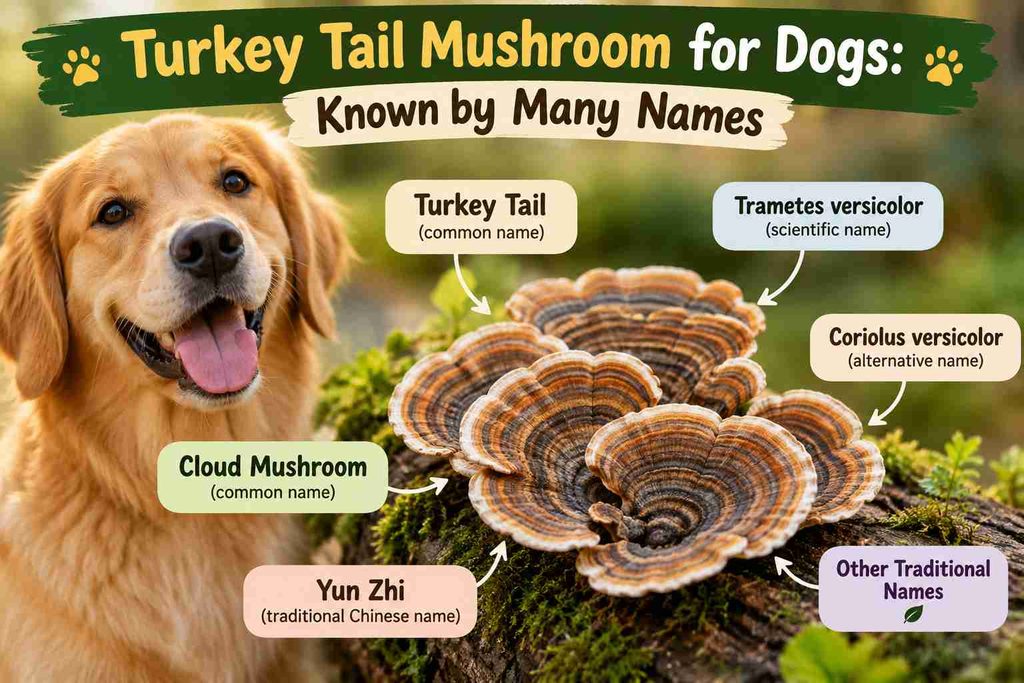
Turkey tail has several names, which can make product labels confusing. You may see Trametes versicolor, Coriolus versicolor, cloud mushroom, yun zhi, or other traditional names.
The species name matters because not every mushroom supplement contains the same material. A trustworthy label should clearly identify what mushroom is being used and whether the product contains fruiting body, mycelium, or an extract. When checking natural products for your dog, it is also important to understand the safety of individual ingredients, such as frankincense and its potential risks for dogs.
If you are comparing mushroom supplements, do not assume that every product marketed for dogs has the same composition. Extraction method, concentration, manufacturing quality, and testing can all affect what is actually in the finished product.
Mushroom-Derived Polysaccharides
Much of the interest in turkey tail comes from mushroom-derived polysaccharides. These include beta-glucans as well as compounds known as polysaccharide-K (PSK) and polysaccharopeptide (PSP).
These substances have been studied for their ability to influence immune responses. Human research on turkey tail compounds is considerably broader than canine research, so results from people should not automatically be presented as proven benefits for dogs.
That distinction is especially important when a supplement is promoted for serious conditions. Turkey tail may have a useful supportive role, but it should not replace diagnosis, surgery, chemotherapy, radiation, or other veterinary treatment when those are needed.
The Penn study: the real numbers, and the real limits
The University of Pennsylvania research is one of the main reasons turkey tail became widely discussed in canine cancer care.
In the 2012 pilot study, 15 dogs with splenic hemangiosarcoma received different daily doses of a standardized PSP product. The highest-dose group received 100 mg/kg/day, and the study reported encouraging results involving tumor progression and survival. However, the trial was very small, and its findings were considered preliminary rather than definitive.
That distinction matters. A small study can identify a promising signal, but it cannot establish that a supplement will produce the same result in every dog.
A larger Penn study published in 2022 included 101 dogs. Some received PSP alone, while other dogs received doxorubicin with either PSP or placebo. The researchers found that adding PSP to doxorubicin did not improve survival.
The newer study does not erase the earlier research. Instead, it gives owners a more complete picture: turkey tail has interesting biological activity and an encouraging early canine study, but the clinical evidence does not support describing it as a proven cancer treatment.
For a dog diagnosed with hemangiosarcoma, conventional veterinary oncology remains essential. Turkey tail should only be considered as part of a veterinarian-guided plan.
Evidence for Turkey Tail Mushroom Benefits
The potential turkey tail mushroom benefits for dogs mainly center on immune-related activity and the compounds found in the mushroom.
Laboratory and human research suggests that beta-glucans and other mushroom compounds can interact with immune cells. However, evidence in healthy companion dogs is much smaller than the evidence available from human medicine and laboratory research.
The most important canine evidence comes from the hemangiosarcoma studies discussed above. The 2012 study produced a promising signal, while the 2022 follow-up did not find a survival improvement when PSP was added to doxorubicin.
This means owners should separate potential support from proven treatment.
Turkey tail may be considered for:
- General immune support
- Supportive care during certain cancer treatment plans
- Complementary care under veterinary supervision
- Dogs whose owners want to discuss evidence-based mushroom supplements with their veterinarian
The evidence is not strong enough to claim that turkey tail prevents cancer, cures cancer, or works equally well for every dog.
Common Uses of Turkey Tail for Dogs
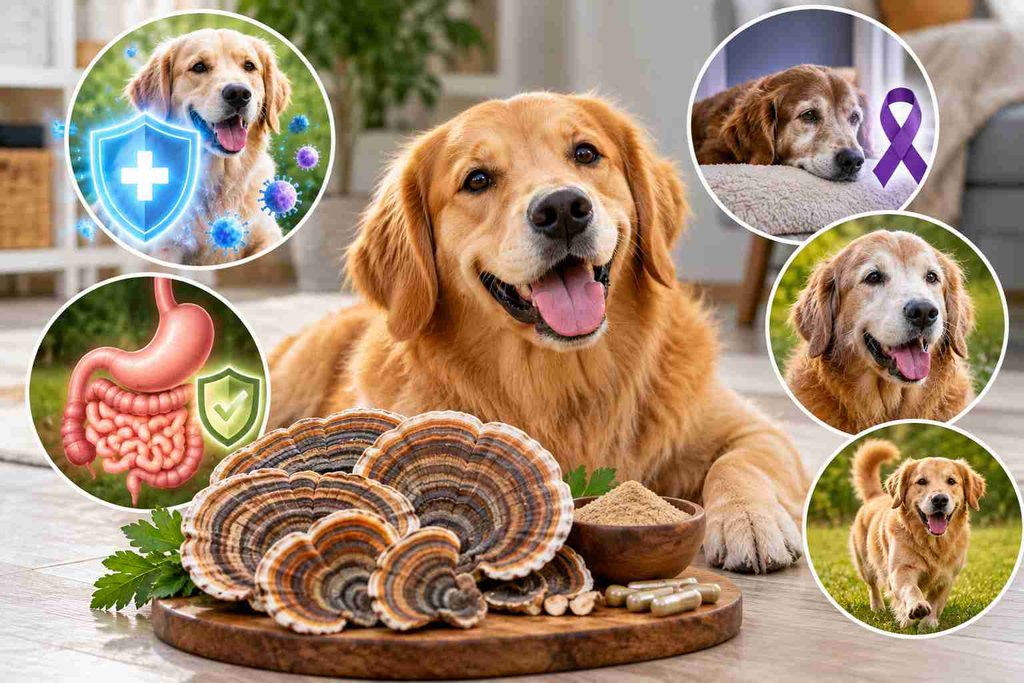
Turkey tail is most often discussed in dogs as a supportive supplement rather than a stand-alone medicine. Its most publicized use is in dogs with cancer, especially hemangiosarcoma, because of the Penn research.
Some owners also consider it for general immune support, particularly in older dogs. However, healthy dogs have not been studied well enough to promise a specific health outcome.
If your dog has a diagnosed disease, the supplement should fit into the veterinary treatment plan rather than become a substitute for it.
Does turkey tail help with fatty lumps on dogs?
There is no good canine clinical evidence showing that turkey tail removes or shrinks lipomas. The Penn studies involved splenic hemangiosarcoma, not benign fatty lumps.
So if you are wondering does turkey tail help dogs with lumps, the safest answer is that a lump needs to be identified before any supplement is considered.
A soft lump may be a lipoma, but appearance alone cannot reliably establish what it is. Your veterinarian may recommend a fine-needle aspirate or another diagnostic test, especially if the lump is new, growing, firm, painful, or changing.
Turkey tail should not be used as a substitute for checking a new lump.
What this means for a dog who is not in that study
A dog without hemangiosarcoma is not automatically represented by the Penn research. The studies involved specific cancer patients and a specific standardized PSP preparation.
For a healthy senior dog, the possible role is different. Owners may be interested in immune support, but controlled evidence for everyday wellness use in healthy dogs is still limited.
That makes realistic expectations important. A supplement can be considered as part of overall care, but good nutrition, appropriate exercise, preventive veterinary visits, dental care, vaccinations, parasite control, and early diagnosis remain much more established parts of canine health.
Choosing a turkey tail supplement: the four checks
A quality turkey tail mushroom supplement for dogs should be easy to understand from its label. Look for four basic things before buying.
1. Clear mushroom material: The label should explain whether it uses fruiting body, mycelium, or an extract.
2. Named beta-glucan content: “Polysaccharides” alone does not tell you exactly how much beta-glucan is present.
3. Independent testing: A certificate of analysis can provide information about identity, potency, heavy metals, microbes, and other contaminants.
4. Clear species and amount: Look for Trametes versicolor or Coriolus versicolor, along with the amount provided per serving.
An organic turkey tail mushroom for dogs may appeal to owners who prefer organic ingredients, but the word “organic” alone does not prove that a product is potent, appropriately extracted, or independently tested.
Avoid products with vague proprietary blends when you cannot determine what mushroom material or quantity your dog is receiving.
Turkey Tail Mushroom for Dogs Dosage and Choosing a Product
There is no single universally established wellness dose for every dog. Products can vary considerably in their mushroom material, extraction process, concentration, and beta-glucan content.
You may find turkey tail mushroom powder for dogs, capsules, liquid extracts, and other forms. Oral products are commonly used, but the correct amount depends on the specific formulation.
This is why a label-based dose should not automatically be converted into a dose for another brand. Two products can contain very different amounts of active compounds even when both say “turkey tail” on the front.
How much turkey tail do you give a dog?
The Penn research used a standardized PSP preparation at doses of 25, 50, and 100 mg/kg/day, but those research doses were used in dogs with a specific cancer and should not be treated as a universal wellness recommendation.
That is why turkey tail dosage for dogs should be based on the exact product and your veterinarian’s advice.
If you are searching how much turkey tail to give dog, do not copy a cancer-study dose simply because your dog weighs a similar amount. Research doses refer to a particular preparation and cannot automatically be transferred to another powder or extract.
The same applies to the question How much turkey tail should I give my dog? Your veterinarian can consider your dog’s weight, diagnosis, medications, health history, and the product’s actual composition before recommending an amount.
Never double a dose after a missed serving.
Turkey Tail Mushroom for Dogs Side Effects
Turkey tail is generally discussed as a well-tolerated supplement, but side effects are still possible. Reported problems with medicinal mushroom supplements can include digestive upset, nausea, vomiting, or diarrhea.
If you are specifically researching turkey tail mushroom for dogs side effects, remember that an individual reaction can occur even when other dogs tolerate the same product.
Stop the supplement and contact your veterinarian if your dog develops persistent vomiting, significant diarrhea, weakness, loss of appetite, facial swelling, breathing problems, or another unusual reaction.
Product quality also matters. Mushrooms can accumulate contaminants depending on where and how they are grown, so testing for heavy metals and other contaminants is an important part of choosing a supplement.
What Not to Mix With Turkey Tail
There is no reliable universal list of medications that every dog must avoid with turkey tail. Interaction evidence in dogs is limited, so extra caution is appropriate when a dog takes several medicines.
Particular attention is warranted with:
- Anticoagulant or blood-thinning medications
- Immune-modulating or immune-suppressing drugs
- Diabetes medications
- Medications used during cancer treatment
- Dogs preparing for surgery
Veterinary sources also advise caution with medicinal mushrooms in pets with bleeding disorders, immune-mediated conditions, liver or kidney disease, and certain other health problems.
If your dog takes prescription medicines, give your veterinarian the complete list before adding a mushroom supplement.
Using Turkey Tail with Other Treatments
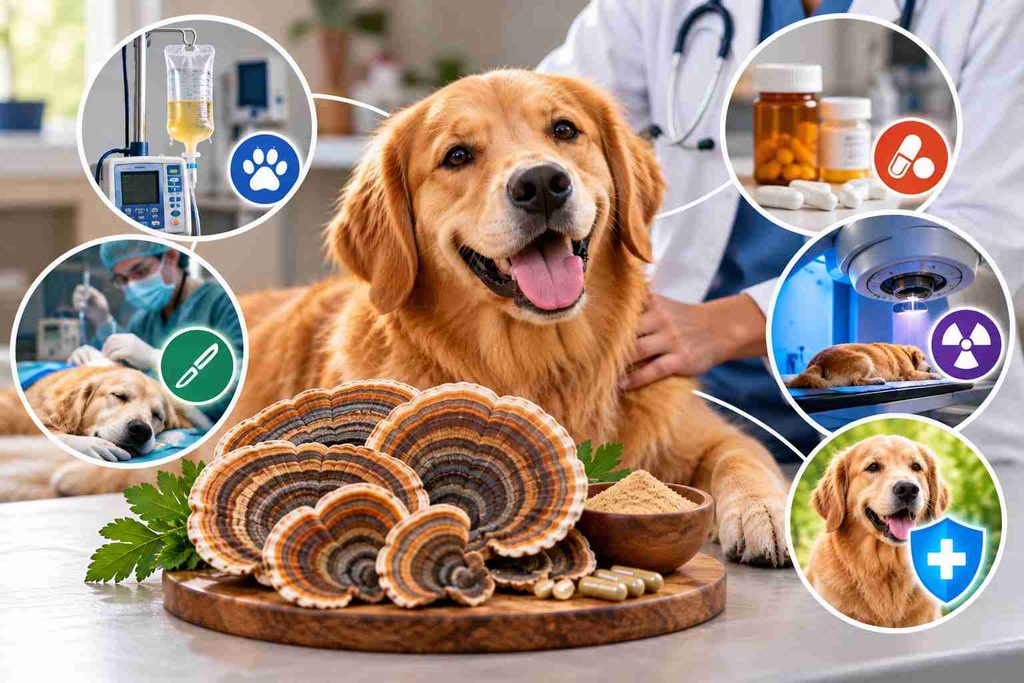
Turkey tail should be viewed as complementary care, not a replacement for established veterinary treatment.
The 2022 Penn study directly examined PSP alongside doxorubicin in dogs with splenic hemangiosarcoma. Adding PSP to doxorubicin did not improve survival, so it would be misleading to promise that combining turkey tail with chemotherapy makes cancer treatment more effective.
If your dog receives chemotherapy, radiation, surgery, immunotherapy, or another treatment, tell the veterinary team about every supplement.
The same rule applies to other natural products. For example, peppermint oil and medicinal mushrooms should not simply be combined because both are marketed as natural products. Each substance has its own safety considerations.
When to Not Use Turkey Tail for Dogs
Turkey tail may not be appropriate for every dog. Extra veterinary guidance is important if your dog has an autoimmune or immune-mediated condition, takes immune-suppressing medicine, has a bleeding problem, has diabetes, has liver or kidney disease, or is preparing for surgery.
Dogs with known mushroom allergies should not receive mushroom supplements without veterinary advice.
You should also avoid feeding unidentified wild mushrooms. If you are asking are turkey tail mushrooms poisonous, the important distinction is between a correctly identified, professionally produced supplement and a wild mushroom found outdoors. Mushroom identification can be difficult, and some wild mushrooms are dangerous to dogs.
For the same reason, do not assume that every mushroom growing on a log is turkey tail. A veterinary professional should be contacted if your dog eats an unknown wild mushroom.
Key Takeaways
- Turkey tail is Trametes versicolor, a mushroom containing beta-glucans and other polysaccharides.
- Early Penn research in dogs with hemangiosarcoma was encouraging, but it involved a small number of dogs.
- A larger 2022 study did not find improved survival when PSP was added to doxorubicin.
- Turkey tail is not proven to cure cancer or shrink ordinary fatty lumps.
- Product quality matters, especially species identification, mushroom material, beta-glucans, dosage information, and contaminant testing.
- Do not copy research doses for another product.
- Ask your veterinarian before combining turkey tail with medications or cancer treatment.
FAQs about Turkey Tail for Dogs
Is Turkey Tail Good For Dogs?
Turkey tail may have a supportive role for some dogs, particularly when a veterinarian is involved, but the evidence for routine wellness use is limited. It should not be presented as a cure for disease.
Is Turkey Tail Safe For Dogs?
For many dogs, professionally prepared turkey tail products appear to be well tolerated, but safety depends on the product, dose, and individual dog. Dogs with certain medical conditions need extra veterinary guidance.
Is Turkey Tail Mushroom Safe for Dogs?
Turkey tail mushroom is generally well tolerated by many dogs when properly prepared and used appropriately, but side effects and drug interactions are possible, so veterinary guidance is recommended.
Does Turkey Tail Help Dogs With Lumps?
There is no reliable evidence that turkey tail shrinks or treats lumps in dogs. Any new, growing, or changing lump should be examined by a veterinarian.
Can Turkey Tail Mushrooms Cause Diarrhea In Dogs?
Yes. Digestive upset, including diarrhea, can occur with medicinal mushroom supplements. If diarrhea is severe, persistent, or accompanied by vomiting, weakness, or loss of appetite, contact your veterinarian.
Does Turkey Tail Shrink Tumors In Dogs?
Current canine evidence does not establish turkey tail as a tumor-shrinking treatment. The Penn research studied progression and survival in dogs with splenic hemangiosarcoma rather than proving that turkey tail directly shrinks tumors.
Does Turkey Tail Shrink Lipomas In Dogs?
There is no established canine evidence that turkey tail shrinks lipomas. A new or changing lump should be examined by a veterinarian rather than treated at home with a supplement.
What Are The Benefits Of Turkey Tail Mushroom For Dogs?
Potential benefits are mainly discussed around immune-related activity and supportive care. Evidence is strongest for research interest in cancer, while benefits for healthy dogs remain less certain.
Which Turkey Tail Product Should I Choose For My Dog?
Look for a product that clearly identifies the mushroom species and material, states the amount per serving, provides beta-glucan information, and offers reliable testing for contaminants. Your veterinarian can help assess a specific product.
How Long Does Turkey Tail Take To Work In Dogs?
There is no reliable timeframe that applies to every dog or every purpose. Response can depend on the product, health condition, and goal. Do not judge a serious disease by supplement response alone.
What Is Loven Turkey Tail For Dogs?
If you see a product or search phrase such as “loven turkey tail for dogs,” check the actual label rather than relying on the product name. Confirm the mushroom species, extract or powder used, amount per serving, beta-glucan content, and quality testing.
Are Turkey Tail Mushrooms Poisonous?
Correctly identified turkey tail is different from unknown wild mushrooms, but dogs should not be allowed to eat unidentified mushrooms outdoors. Some mushroom species can cause severe poisoning, so identification matters.
Can Turkey Tail Be Given To Dogs With Cancer?
It may be considered as complementary care, but the veterinarian managing the cancer should approve it. Current canine evidence does not support replacing standard cancer treatment with turkey tail.
Wrapping this up
Turkey tail mushroom is one of the more closely studied medicinal mushrooms in canine cancer research, but its story is more nuanced than supplement marketing often suggests.
The 2012 Penn study created genuine interest after encouraging findings in dogs with hemangiosarcoma. The larger 2022 follow-up then showed why those early findings needed confirmation. That is exactly why responsible pet care should focus on the complete evidence rather than one exciting result.
For pet parents, the practical message is simple: choose transparent products, avoid wild mushrooms, follow product-specific guidance, and involve your veterinarian before adding turkey tail to a dog’s treatment plan.
When used thoughtfully, a supplement can be one small part of supportive care. It should never replace a proper diagnosis or the veterinary treatment your dog needs.